TOPIC SEARCH: PubMed | Google Scholar | Pub
What is bone marrow involvement?
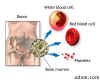 The bone marrow is a soft tissue that is inside some of the larger bones. It contains stem cells which develop into the three different types of blood cell: red blood cells white blood cells, and platelets.
We can think of the bone marrow as a nursery for all blood cells. Since normal cells are present in the marrow, it's not unusual or unexpected that lymphoma cells will also present in this organ. The involvement in the marrow is determined and measured by a biopsy - a sample of the cells in the region.
Lymphoma cells can accumulate in the marrow to a degree that they crowd out normal cells and inhibit the "birth" of normal blood cells from stem cells. This may lead to a decrease in red blood cells (anemia, leading to fatigue) or platelets (thrombocytopenia, risk of bleeding), or other white blood cells (neutropenia, increased risk of infection) etc., which would be detected by blood tests.
The list of complications sounds ominous, but watching your counts is one important way that our doctors monitor the condition and make decisions about when to treat. We don't always get into trouble from lowering counts .. the lymphoma does not always accumulate in the marrow to a degree that causes such problems. It may be at say 20% involvement and stay that way for many years. Some of us may have little or no bone marrow involvement. Each case can be unique.
Importantly, lymphoma in the marrow can be treated effectively, just as well as lymphoma cells that accumulate in lymph nodes. The blood counts will improve with effective treatment.
Is bone marrow involvement common in lymphoma?
It's common to be diagnosed with lymphoma at an advanced stage (III or IV) and with bone marrow involvement. While this might seem alarming, you should know that advanced stages of lymphoma can be treated successfully, and that lymphoma in the bone marrow is as reversible with treatment as lymphoma anywhere in the body.
One way to understand this is to compare lymphoma with a so-called solid tumor, such as a prostate cancer. Here the cell of origin of the cancer does not normally exist anywhere but in the prostate. So when you find malignant prostate cells in the bone marrow, you have a serious problem. For blood cells, however, we expect these cells to be anywhere in the lymphatic or circulatory system, including the bone marrow.
.gif) |
Bone marrow involvement and survival for low grade NHL? PubMed | Related articles
"The presence of bone marrow infiltration at diagnosis did not significantly affect the prognosis of
low grade non-Hodgkin's Lymphoma."
|
A diagnosis of lymphoma in the bone marrow can only be established by obtaining a bone marrow specimen for analysis - a bone marrow biopsy. This test might be done for staging purposes in order to provide a baseline of where the lymphoma is so that it can be monitored for progression, guide treatment, and judge response to subsequent treatment.
The clinical significance of bone marrow involvement can vary based on the type of lymphoma. It seems to have prognostic value for DLBCL for example.
|
Cancer Res Treat. 2013: Clinical Outcome of Rituximab-Based Therapy (RCHOP) in Diffuse Large B-Cell Lymphoma Patients with Bone Marrow Involvement http://1.usa.gov/1oHy9Rr
BM involvement at diagnosis affected the survival of patients with DLBCL who received RCHOP.
Although use of RCHOP can result in significant improvement of the therapeutic effect of DLBCL,
BM involvement is still a negative prognostic factor of DLBCL patients in the era of rituximab. |
A negative bone marrow result means that there's an improved chance that the marrow is clean or relatively clean, but it's not a conclusive result. Similarly, if we scooped a bucket of water out of a swimming pool at night we might find no leaves in the bucket - but we could not conclude the pool is without leaves - only that the sample we took did not find any.
Imaging such as MRI or PET can "help increase the positive yield of bone marrow biopsies by guiding the marrow sampling procedures to sites of relatively hypercellular marrow." (Magnetic Resonance Imaging of the Bone Marrow in Hematologic Malignancies bloodjournal.org)
Bilateral testing (taking sample from both sides) will be more reliable: (Bone marrow biopsy for the staging of non-Hodgkin's lymphoma: bilateral or unilateral trephine biopsy? Tumori. 1995 Nov-Dec;81(6):410-3. PMID: 8804465 | Related articles)
NOTE: Lymphoma cells are very very small. For example, a one centimeter tumor has about 1 billion lymphoma cells. A few number of lymphoma cells will not be detected by many standard tests. Only a significant number of cells sufficient to form a mass (a tumor) will be detected by imaging and other tests.
One very sensitive test for lymphoma cells is called PCR. It can detect for the presence of genetic translocations (that are unique to some kinds of lymphoma in the sample).
Returning to the analogy of testing for leaves in a pool, a sample taken with a bucket that has no leaves (tumors) might have small traces of leaf fragments (individual tumor cells) that are not visible with plain sight, which might be detected by other, more sensitive, tests.
Bcl-2/ t(14;18) Gene Rearrangement, Quantitative Real-Time PCR Questdiagnostics
"The t(14;18) translocation is characteristic of B-cell lymphomas, occurring in up to 90% of follicular lymphomas. It is also found in 20% to 30% of diffuse large B-cell lymphomas ..."
Also see: What is PCR Testing? PAL MRD topic page