.gif) |
NEW Going Home After Your Autologous Stem Cell Transplant NYU
Guide for Patients and Caregivers
|
|
BMTinfoNet - bmtinfonet.org
Highly recommended. A nonprofit that specializes in SCT information and support.
|
About transplants - bmtinfonet.org
|
|
Search for Stem cell Transplant Centers - BMTinfoNet
Also provides: background, Number of Transplants done,
Minimum Donor Match Criteria, Contacts, Support Groups Available
|
|
|
Bone Marrow Transplant (BMT) - makna.org
|
|
Radioimmunotherapy based conditioning regimens for stem cell transplantation - FULL text http://bit.ly/bhbmmg
|
|
Common Questions nbmtlink.org
|
|
Understanding your Transplant - cancer.med.umich.edu
|
|
Managing Indolent Lymphomas in Relapse - asheducation.org (fixed)
Working Our Way Through a Plethora of Options (includes SCT guidance)
|
|
Blood and Marrow Transplant Resources. www.bmtresources.org
|
7 Phases of the Transplant Process - bmtresources.org
|
|
|
High-Dose Therapy and Autologous Hematopoietic-Cell Transplantation for Follicular Lymphoma Beyond First Remission: The Stanford University Experience - Biology of Blood and Marrow Transplantation 7:294-301 (2001) - PDF
|
|
SCT for Low grade Lymphoma - asheducationbook.org /2004 full text | PAL's readable version
"In Section III, Dr. Koen Van Besien provides a well-documented update on outcomes associated with autologous and allogeneic stem cell transplantation for FL. The results of trials of autologous stem cell transplantation in first remission and recent data supporting a role for graft purging are discussed. Based on the premise that a graft-versus-lymphoma effect is operative in FL, reduced-intensity allogeneic transplantation is the preferred approach in many cases, and recently reported results are summarized. Criteria for patient selection and the optimal role of transplantation in the overall therapeutic plan for the patient with FL are presented."
|
|
Support group for SCT:
ACOR BMT-Talk - Support Groups
|
|
Types of Transplants & Diseases Transplanted - MSKCC
|
|
Survivorship & Support - MSKCC
|
|
Patient SCT Stories - Cyberfamily | What to take to Hospital - Cyberfamily
|
|
The Role of Autologous Transplantation in the Management of Mantle Cell Lymphoma:
A Study From the EBMT E. Vandenberghe, C. Ruiz de Elvira, P. Isaacson, E. Lopez-Guillermo, E. Conde, C. Gisselbrecht, F. Guilhot, A. Goldstone, N. Schmitz - PDF
|
|
Re-immunization after SCT
|
|
Rituximab and ICE (RICE) as second-line therapy before autologous stem cell transplantation for relapsed or primary refractory diffuse large B-cell lymphoma bloodjournal.hematologylibrary.org
|
|
High-Dose Therapy Improves Progression-Free Survival and Survival in Relapsed Follicular Non-Hodgkin’s Lymphoma: Results From the Randomized European CUP Trial Full text jco.ascopubs.org
n = 140 patients were registered from 36 centers internationally, and 89 were randomly assigned
From this randomized trial, we conclude that HDT followed by autologous stem-cell transplantation (in patients with relapsed follicular NHL) translates into improved PFS (for the three-arm comparison) and overall survival (comparing the chemotherapy patients with the UP patients combined). The data do not provide evidence to suggest that purging of the stem-cell graft improves outcome. Despite the relatively low numbers of patients randomized, the data are important since the patient groups were well-balanced according to patient (including IPI) and treatment characteristics.
|
|
Auto SCT vs. CHVP + interferon in untreated follicular lymphoma: High-dose therapy followed by autologous purged stem cell transplantation and doxorubicin-based chemotherapy in patients with advanced follicular lymphoma: a randomized multicenter study by the GOELAMS with final results after a median follow-up of 9 years Blood 2009 113: 995-1001
n = 172 previously untreated pts with follicular lymphoma, transformed excluded
randomized for either immunochemotherapy or high-dose therapy (HDT) followed by purged ASCT.
Copying from Discussion: "Progress has been achieved in the treatment of FLs, with the use of polychemotherapy and rituximab combinations.5,6,42,43 Therefore, despite a high CR rate and prolonged PFS, ASCT cannot be considered as the standard first-line treatment for FL patients with high tumor burden as defined in our study. The GITMO Italian group recently reported the results of a randomized trial comparing CHOP-rituximab to high-dose chemotherapy with rituximab (R-HDS) in high-risk FL. Despite improved PFS and EFS, OS was not different in the 2 arms (82% vs 79% at 4 years, with a median follow-up of 50 months) because of the high level of effectiveness of R-HDS as salvage therapy.17 Therefore, if ASCT has to be recommended for disease progression or relapsing patients, our encouraging results with a plateau suggest a potential benefit of ASCT for a small subgroup of patients with specific prognostic factors at diagnosis, which remain to be determined or which could be the absence of clinical or molecular remission after conventional first-line therapy. Although in vitro purging has to be stopped, the results of ASCT may be improved by combination with in vivo purging with rituximab, maintenance treatment with rituximab, and/or radioimmunotherapy as part of the conditioning regimen."
|
|
Auto SCT with RIT: Radioimmunotherapy (Zevalin®) Combined with BEAM Conditioning Regimen and Autologous Stem Cell Transplantation for the Treatment of NHL ash.confex.com
n=53, relapsed and refractor (16 follicular, 37 aggressive) , age 65 or less.
In pts with different histology nHL, who failed to achieve CR after previous immuno-chemotherapy, RIT integrated with high-dose chemotherapy (Z-BEAM) is capable to induce 86% of ORR, 74% of CR and 3 ys EFS of 64%, with sustained engraftment and an acceptable extra-haematological toxicity, mainly restricted to pts older then 65 yrs.
|
|
Outcome: Radioimmunotherapy with 131-I tositumomab (Bexxar) enhanced survival in good prognosis relapsed and high-risk diffuse large B-cell lymphoma (DLBCL) patients receiving high-dose chemotherapy and autologous stem cell transplantation. ASCO 2007
Conclusions: The addition of 131-I tositumomab to BEAM and autologous stem cell transplant for relapsed or high-risk chemosensitive DLBCL produces a 3-yr OS of 81% without excess toxicity. This compares favorably to historical controls. This regimen is currently being tested in a phase III trial in the BMT/CTN of Rituximab/BEAM vs. 131-I tositumomab/BEAM in patients with relapsed chemosensitive DLBCL.
|
|
Outcomes: High-Dose Therapy (HDT) and Autologous Stem-Cell Transplantation (ASCT) in Angioimmunoblastic Lymphoma: Complete Remission at Transplantation Is the Major Determinant of Outcome J Clin Oncol. 2007 Dec 10; PMID: 18071187
This study shows that HDT and ASCT offers the possibility of long-term disease-free survival to patients with AITL. Early transplantation is necessary to achieve optimal results.
|
|
Pilot study: High activity [escalating doses of] Zevalin® with peripheral blood progenitor cells support [followed by ASCT] in patients with refractory/resistant B-cell non-Hodgkin lymphomas blackwell-synergy.com/
... high-activity Zevalin® with ASCT is feasible and could be safely delivered in elderly and heavily pretreated NHL patients, including those who previously received high-dose chemotherapy and ASCT.
|
|
Expert review Autologous transplantation for follicular lymphoma? Not too soon! - bloodjournal.hematologylibrary.org/
The overall role of ASCT in follicular lymphoma continues to be debated. It is an excellent treatment option for the management of younger patients with recurrent disease.4 In advanced newly diagnosed lymphoma, a survival advantage has yet to be shown; with more prolonged follow-up it may still emerge in the GLSG study.
|
|
Harvesting stem cells: Intermediate dose etoposide plus G-CSF 16 g/kg is more effective than cyclophosphamide 4 g/m(2) plus G-CSF 10 g/kg in PBSC mobilization of lymphoma patients.
Leuk Lymphoma. 2007 Oct;48(10):1950-60. PMID: 17917963
Intermediate dose etoposide + G-CSF 16 microg/kg is a highly effective mobilizing therapy, further, it has the advantage of low hematologic toxicity and can be easily administered as outpatient treatment.
|
|
Prognostic factors & auto SCT: The pre-transplant FLIPI Index is associated with survival of follicular lymphoma patients undergoing autologous stem cell transplantation.
Leuk Lymphoma. 2007 Oct;48(10):1961-7. PMID: 17917964
The association of FLIPI with survival appeared to be more relevant for patients who received standard conditioning regimens compared to those that were treated with high-dose radioimmunotherapy (p = 0.004).
Among all patients, mortality was also associated with chemosensitive disease (HR = 0.47, p = 0.01) or untreated relapse (HR = 0.20, p = 0.0002) vs. chemoresistant disease, and >/=2 extranodal sites (HR = 2.82, p = 0.03) after adjusting for FLIPI.
These data suggest that the FLIPI and select non-FLIPI factors after adjustment for the FLIPI are associated with survival in FL patients undergoing ASCT.
|
|
The impact of histologic grade on the outcome of high-dose therapy and autologous stem cell transplantation for follicular lymphoma - nature.com
|
|
High-Dose Bexxar® with Stem Cell Support Effective in Elderly B-Cell NHL - professional.cancerconsultants.com
"In the current study, 24 patients older than 60 years with refractory or relapsed B-cell lymphoma were treated with myeloablative doses of Bexxar followed by autologous stem cell infusions. Patients in this study were a mixture of high and low-grade NHL. This was a heavily pretreated group of patients and over half were deemed resistant to treatment. These authors reported a 3 year overall survival of 59% and a progression-free survival of 51%. There were no treatment-related deaths and toxicities were generally mild."
|
|
Factors associated with outcomes in allogeneic hematopoietic cell transplantation with nonmyeloablative conditioning [mini alloSCT] after failed [conventional] myeloablative hematopoietic cell transplantation.
J Clin Oncol. 2006 Sep 1;24(25):4150-7. Epub 2006 Aug 8. PMID: 16896000
Factors associated with better overall survival were PR or CR (P = .01) and lack of comorbidity (P = .03) at HCT and absence of acute GVHD after HCT (P = .06). CONCLUSION: Encouraging outcomes were seen with allogeneic HCT after nonmyeloablative conditioning in selected patients who had experienced relapse after a high-dose HCT, particularly in patients with non-Hodgkin's lymphoma. Results with unrelated grafts were comparable with results with related grafts.
|
|
A long-lasting third complete remission after second autologous transplant followed by maintenance treatment with rituximab in a patient with diffuse large cell non-Hodgkin's lymphoma.
Am J Hematol. 2006 Aug 2: No abstract available. PMID: 16886214
|
|
A Phase I/II Trial of High-Dose Yttrium 90 ibritumomab tiuxetan in Combination with High-Dose Etoposide and Cyclophosphamide Followed by Autologous Stem Cell Transplant in Patients with Poor-Risk or Relapsed Non-Hodgkins Lymphoma (NHL). Blood. 2005 Jul 7; PMID: 16002426
No outcome data, but ... "We conclude that high-dose (90)Y ibritumomab tiuxetan can be combined safely with high-dose etoposide and cyclophosphamide without increase in transplant-related toxicity or delayed engraftment."
|
|
Radioactive Anti-CD 20 Antibody (Bexxar®) May Improve Outcome of Autologous Transplants for Follicular Lymphomas - cancerconsultants.com
|
|
Phase I Trial of Iodine-131 Tositumomab (Bexxar) With High-Dose Chemotherapy and Autologous Stem-Cell Transplantation for Relapsed Non-Hodgkin's Lymphoma - jco.org
|
|
High-dose CEB vs BEAM with autologous stem cell transplant in lymphoma. [BEAM is the winner.]
Bone Marrow Transplant. 2004 Jul 26 PMID: 15273714 | Related abstracts
|
|
Myeloablative radiochemotherapy followed by autologous stem cell transplantation in first remission prolongs progression-free survival in follicular lymphoma - results of a prospective randomized trial of the German Low-Grade Lymphoma Study Group (GLSG). Blood. 2004 Jul PMID: 15238420
|
|
Rituxan® Prior to Autologous Stem Cell Transplantation may Improve Outcomes in non-Hodgkin's Lymphoma - CancerConsultants.com 3/04
|
|
Autologous bone marrow transplantation for marginal zone non-Hodgkin's lymphoma.
Leuk Lymphoma. 2004 Feb;45(2):315-20. PMID: 15101717 | Related abstracts
|
|
[872] Long Term Results of Radioimmunotherapy with Bexxar/BEAM and Autologous Stem Cell Transplantation (ASCT) for Chemotherapy Resistant Aggressive - ASH 2003
|
|
Auto SCT - treatment-related mortality: Effect of cumulative etoposide doses on the outcome of autologous peripheral-blood progenitor-cell transplantation for lymphoma. Bone Marrow Transplant. 2004 Jan 19 PMID: 14730338
|
|
Auto SCT: Rituximab and ICE (RICE) as second-line therapy prior to autologous stem cell transplantation for relapsed or primary refractory diffuse large B-cell lymphoma. Blood. 2004 Jan 22 PMID: 14739217
|
|
|
|
Immunotherapy w/ autoBMT - medscape (free login req.)
|
|
CD34+-Enriched Peripheral Blood Progenitor Cell Collections in Lymphoma Autotransplants Are Associated With Increased Morbidity, Hillard M. Lazarus et al. - PDF m
|
|
Involved-Field Radiation Therapy as an Adjunct to the Autotransplant Preparative Regimen for Lymphoma
David P. Schenkein, et al. - PDF mmserver.cjp.com
|
|
COMPARING WITH SALVAGE TREATMENT: Autologous bone marrow transplantation as compared with salvage chemotherapy in relapses of chemotherapy-sensitive non-Hodgkin's lymphoma. N Engl J Med. 1995 Dec 7;333(23):1540-5. PMID: 7477169 - PubMed
|
|
FRONT LINE TREATMENT: Value of autologous stem cell transplantation with purged bone marrow as first-line therapy for follicular lymphoma with high tumor burden: a GOELAMS phase II study. Bone Marrow Transplant. 2000 Nov;26(9):971-7. PMID: 11100276 - PubMed
|
|
EFFICACY DATA: Long-term follow-up of autologous bone marrow transplantation in patients with relapsed follicular lymphoma. Blood. 1999 Nov 15;94(10):3325-33. PMID: 10552941 PubMed abstract
|
|
EFFICACY DATA: High-dose therapy with autologous bone marrow support as consolidation of remission in follicular lymphoma: long-term clinical and molecular follow-up. J Clin Oncol. 2000 Feb;18(3):527-36. PMID: 10653868 PubMed abstract
|
|
OPTIMIZING: Improve the Outcome of Autologous Hematopoietic Cell Transplantation! Karl G. Blume Stanford University School of Medicine, Stanford, California - Abstract-WEB | Full-PDF | PDF-Help
|
|
OPTIMIZING: Bcl-2 clearance: optimizing outcomes in follicular non-Hodgkin?s lymphoma - Bone Marrow Transplant
2002 Feb;29 Suppl 1:S14-S17. PMID: 11840156
|
|
REVIEW: Graft purging in autologous bone marrow transplantation: a promise not quite fulfilled.
Oncology (Huntingt). 2004 Jun;18(7):867-76; discussion 876-8, 881, 884. Review. PMID: 15255171 | Related articles
|
|
REVIEW: Role of autologous bone marrow transplantation in non-Hodgkin's lymphoma. Hematol Oncol Clin North Am. 1993 Jun;7(3):577-90. Review. PMID: 8102135 - PubMed abstract
|
|
REVIEW: Bone marrow transplantation for non-Hodgkin's lymphoma: a review. Am J Med Sci. 1997 Apr;313(4):228-35. Review. PMID: 9099153 abstract
|
|
REVIEW: Biology of Blood and Marrow Transplantation (abstracts for Lymphoma) Web
|


 PubMed TOPIC SEARCH:
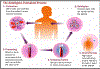 In an autologous stem cell transplant, stem cells from the patient's own marrow are "harvested," stored and then returned to the body (engrafted) after the patient receives high doses of chemotherapy and/or radiotherapy conditioning therapy.