Ask Question
   Sign Guest book

Search Site


About Lymphoma
| Advocacy | Art | CAM & Life Style | Clinical trials | Docs | Centers | Guidelines at Diagnosis | Side Effects | Support | Symptoms | Tests | Treatments | Types of Lymphoma

Independent of industry funding, PAL depends on your support!

tax deductible

Patients Against Lymphoma


Clinical TrialsFocus on Clinical Trials

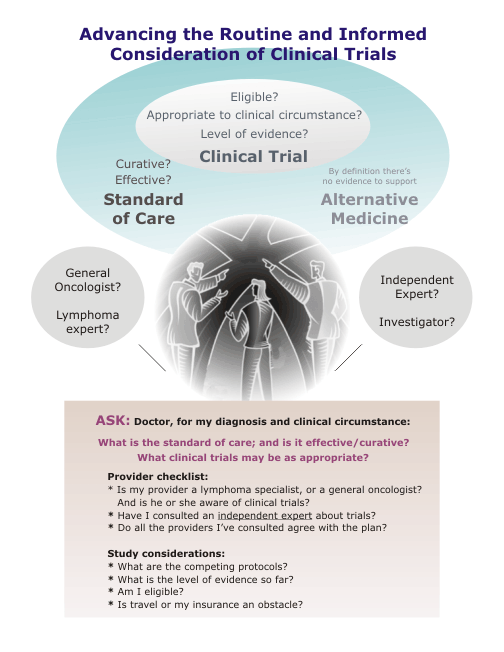
Advancing the Informed and Routine Consideration of Clinical Trials

Last update: 04/24/2013

"Looking on a forum I frequent, I found a post by Patients Against Lymphoma. It listed many clinical trials around the country. One was a trial at U of M only 50 miles from me. I qualified, and that trial gave me the hope of a better outcome that I was looking for."

~ Tom (WebMagic forum)


Essentials for Patients:

bullet

How To Inquire About Clinical Trials

bullet

7 Reasons to Consider Clinical Trials based on our clinical circumstances

bullet

Questions for Your Doctor about Trials

bullet

A way to start the conversation about trials (bring our survey to your next consult)  

bullet

PAL Can Help You to
Find Trials:

- Our Search Tools

- Agent-based trials
 
- Trials by Type of Lymphoma and Treatment Status

- Trials of Interest

bullet

Our Travel and Lodging Resource page

Background for patients:

bullet

Clinical Questions that Can Be Only Answered by Clinical Trials

bullet

Conflict of Interest in Medical Decision-making

Key questions for patients:

bullet

What is the natural history of my type of lymphoma, and how effective is the standard of care? 

bullet

What are my unique risk factors?

bullet

What clinical trials are appropriate as therapy for my circumstance - which seem to compare well with the standard of care?

Research Advocacy

Our projects:

bullet

Our Clinical Trial Surveys and Advocacy Projects

Oncologist survey (open)
 
Patient survey (complete) Report and JCO abstract

bullet

Proposal for ClinicalTrials.gov (open) 

Background:

bullet

The Terrible impact of low enrollment on clinical research 

And related articles on the crisis in clinical research

RELATED TOPICS

Four basic goals of therapy
7 Reasons to Consider Trials - based on clinical circumstance
How To Inquire About Clinical Trials
Questions for Your Doctor about Trials
Clinical Questions that Can Be Only Answered by Clinical Trials
Conflict of Interest in Medical Decision-making

Here we provide information and tools to assist patients, caregivers, and treating physicians in the routine and informed consideration of clinical trials.

See Clinical Questions that Can Be Only Answered by Clinical Trials

Our premise is that we can only consider and utilize what we know to exist; and that patients should participate in a study ONLY when the protocol compares well to the standard of care as a treatment decision.

See 7 Reasons to Consider Clinical Trials:
based on our clinical circumstances

Our concern is that the clinical trial referral system is letting us down - is not adequate to make good on the growing promise of clinical science, which is reflected in the large number of lymphoma studies actively seeking participants.

As of December 2010, there are more than
1,300 clinical trials actively recruiting patients. 

See All lymphoma/CLL studies, ClinicalTrials.gov

That is, the trial enrollment system has not kept pace with innovations, leading to what we call a "poverty of riches" - an increasing number of targeted agents with a potential to improve our care, in danger of not being adequately tested.

Goals

Patients and treating physicians to become active partners in clinical research -
as participants but also as consultants in the design of studies.

bullet

To educate patients about the purpose of clinical trials, and how participation can SOMETIMES be in our best interest.

See
Clinical Questions that Can Be Only Answered by Clinical Trials
See 7 Circumstances to Consider Trials

bullet

To notify patients in the support forums about trials of interest, providing also background on the agents and prior study results when possible.

bullet

To provide doctors and patients with better tools to locate studies that are appropriate to our clinical circumstances and treatment goals.  

bullet

To educate the public about the crisis in clinical research - the need for new policy to make the consideration of trials routine.

See
The Terrible impact of low enrollment on clinical research 

bullet

To provide incentives for community physicians to refer patients to appropriate clinical trials.

bullet

To educate patients about how to inquire about trials with their treating physicians and independent experts. 

See Treatment Decision Tree
See How To Inquire About Clinical Trials

bullet

To educate investigators and sponsors about the importance of providing the rationale for clinical trials protocols as a treatment decision - to help to improve and foster trust in the clinical research system - and guide clinical trial design.
 

bullet

To advocate for a effective clinical trial referral process (as part of normal care) and the enhancement of existing tools (ClinicalTrials.gov) so that we can easily locate and consider studies appropriate to our clinical circumstances.

See Proposal for ClinicalTrials.gov (open) 
See Our Tools to Help You Find Lymphoma Trials

bullet

To help patients and caregivers to locate and understand information on the
1) natural history of the disease, 2) the standard of care, and
3) available clinical studies for each lymphoma subtype - noting that an understanding of each is required to achieve informed consent.
 

bullet

To provide information and links to resources on travel and lodging, a known obstacle to clinical trial participation. 

See Our Travel and Lodging Resource page


7 Reasons to Consider Clinical Trials: 
based on your clinical circumstances

PDF brochure

Itemized List below

Meeting the dual requirements: Good Science AND Good Medicine

Preamble: Regarding the 7 Reasons to Consider Clinical Trials.

Cure can be a feasible goal of therapy for some if not eventually all types of lymphoma, even at an advanced stage.  We define cure, as an outcome where the disease never returns, or never returns to a level that is detectable or clinically relevant. 
 
The urgency to go for a cure depends on the anticipated clinical course. 

From necessity, cure is often the goal of therapy for aggressive lymphoma.   For indolent lymphomas there is less potential but also less urgency to cure.  Fortunately it can remain stable for years.

Thus, we need to consider 1) the risks of the disease, 2) the risks of treatments, and 3) the potential to achieve the goal with current regimes. 

The potential to cure is also based on our unique clinical circumstance, such as the sensitivity of the lymphoma to prior therapies, our general health and age. 

For example, an allogeneic stem cell transplant can cure, but it also has significant risks, including treatment-related death, and therefore it might not compare favorably to management of a lower-risk disease treated with lower-risk therapies.
 
Risk and uncertainty are not exclusive to investigational therapies and sometimes clinical trials can compare very well to standard approaches as treatment decisions – the case we make here in this pamphlet.

Thus we need to ask informed questions and to rely on experts to help us with these complex decisions.


FOUR BASIC GOALS OF THERAPY

For the patient agreeing to participate in a clinical trial is a treatment decision.  The science is a secondary consideration.   It is the clinical context  -- such as the type of lymphoma, our age, general health, and our treatment history -- that dictates the most reasonable goal of therapy - be it regular treatment or a clinical trial.   

See also Factors that can influence the timing and choice of therapy

bullet
Management approach: To manage a lower-risk lymphoma as needed with therapy having lower toxicity  - for a lymphoma that is challenging to cure with standard therapy  and the patient's preference or need is to avoid more aggressive therapy. 
bullet
Palliative or best supportive care: To relieve symptoms or to address select areas based on immediate needs - similar to the management approach, but based on what is possible instead of what is preferred.
bullet
Curative intent: To achieve a possible cure - for higher-risk aggressive lymphoma or for a lymphoma with a variable clinical course that is readily curable with standard therapy.
bullet
Durable remission: To achieve a durable remission for a lymphoma that has a variable clinical course - when achieving this goal is realistic with standard therapy and  could possibly improve survival.

Patient-Centered Criteria

CONSIDER A TRIAL WHEN:

1.  Standard treatment is not yet curative or highly effective;

AND the study protocol has shown (from preliminary evidence*) that it might have the potential to cure, or to improve the outcome - leading to better and longer-lasting response with less risk and toxicity.

2. Standard treatment is curative, but relapse is common;

AND the study protocol has shown (from preliminary evidence*) that it may
improve the cure rate.

3. Standard treatment is curative, but also has significant late toxicities;

AND the study protocol has shown (from preliminary evidence*) that it might be as effective but safer.

4. Standard treatments are not safe for me (because of age/ illness);

AND the study protocol has shown (from preliminary evidence*) that it might have lower toxicity.

5a. Observation is recommended for me, because I have an indolent cancer that does not yet require therapy;

AND the study protocol has low expected toxicity and has shown (from preliminary evidence*) that it might have the potential to delay the need for more toxic treatment.

5b.  Management is judged a reasonable approach for a lower-risk lymphoma

AND the study protocol has low expected toxicity and has shown (from preliminary evidence*) that it might have the potential to delay the need for more toxic treatment.

6. The cancer is resistant (refractory) to standard therapy;

AND the study drugs work by a new mechanism – having shown (from preliminary evidence) that it might have the potential to be effective when standard therapies are not.

7. There is no known best treatment for my cancer (a choice is provided);

AND I have no preference and the study protocol will help discover which approved
protocol is best for which patient in future.

* The strength of preliminary evidence can range from strong to very weak. For example, outcome reports from large randomized clinical trials in a population with similar clinical circumstance and the same diagnosis could be considered strong evidence – providing high confidence that the outcomes in the study predict results for others in this circumstance; a small single-arm study generally provide only modest indications or signals of the potential of a protocol to meet clinical needs; and pre-clinical studies (based on animal models) are considered a starting point only – very weak evidence the drug or protocol could provide clinical benefit.


Discussion:

Standard therapies are interventions proven to provide meaningful clinical benefit relative to the natural course of the disease or the disease treated differently.

However -- depending on the type of cancer, the stage, and patient characteristics --standard therapies can sometimes have significant limitations, side effects and risks.  … For example, not everyone will benefit from it, the benefit might not be long-lasting, and the risks and side effects can be significant.

From our perspective, clinical trials deserve to be routinely considered when the study protocols exist that are judged to be potentially as good as or better than standard options, specific to our diagnosis and clinical circumstance.

PDF version for printing and free distribution PDF


Questions to Ask Your Doctor or Nurse

Is there a study that's right for me (at this center or nearby)?

If so:

bullet

What is the purpose of the study?

bullet

How might I benefit from participating?

bullet

What are the risks from participating?

bullet

What were the results of other studies of this treatment?

bullet

What other treatments could I receive if I don't take part in the study?

bullet

How do the risks and potential benefits of the study compare with the standard of care for my clinical circumstance?

(Circumstance?  Our diagnosis, treatment history, risk factors.)

If I join the study:

bullet

How am I protected from possible adverse events?

bullet

What tests are in the study, and how often are they given?

bullet

Can I decide to stop participating at any time?  (Yes, you can)

And if so, will it affect the care I receive? (No, it will not)

bullet

Will I continue to see my current doctor?

bullet

How will participating effect daily activities? Will I still be able to work or go to school?

bullet

Will I have to be in the hospital?   How many days?

bullet

What are the possible risks or side effects for me?

bullet

Will my insurance cover procedures and tests?

If not, will the drug sponsor cover it?

bullet

Will there be extra costs because of the study?

bullet

How will I be checked after the study, and how often?

bullet

How long will the study last and how long will I be tested?

bullet

Will I be made aware of the results?


The Terrible impact of low enrollment on clinical progress

One in Five Cancer Clinical Trials Is Published: 
A Terrible Symptom—What's the Diagnosis?

http://theoncologist.alphamedpress.org/cgi/content/full/13/9/923  
bullet
"half of the unpublished trials have failed to accrue and reach endpoints; 
bullet
Nearly 60% of trials opened for 5 years had fewer than five patients enrolled at each site, and, for >20% of studies, not a single subject had been accrued.
bullet
of all NCI phase I, II, and III trials opened and closed between 2000 and 2007, 
only 50%–60% achieved minimal stated accrual goals. 
bullet
So, while perhaps only one in five cancer clinical trials is ever published, 
of those unpublished, a significant percentage probably died for lack of accrual.


Related Reports

bullet
Lymphoma Expert Calls for Focus on Clinical Trials http://bit.ly/fayxR9

“We have too many drugs. We are diluting our efforts with too many clinical trials; some of them probably ask marginal questions that may not be very important. We really need to prioritize the questions we ask to advance the field. Otherwise we will be stuck with R-CHOP for the next 30 years.”
bullet
A National Cancer Clinical Trials System for the 21st Century: Reinvigorating the NCI Cooperative Group Program http://bit.ly/a2rUEh

"Clinical trials that test the safety and therapeutic benefit of promising treatments are essential in translating new knowledge into tangible benefits for patients with cancer.
Four overarching goals should guide improvement efforts:
 
bullet

Improving the speed and efficiency of the design, launch, and
conduct of clinical trials

bullet

Making optimal use of scientific innovations

bullet

Improving selection, prioritization, support, and completion of clinical trials

bullet

Fostering expanded participation of both patients and physicians

IOM Report: A National Cancer Clinical Trials System for the 21st Century
Reinvigorating the NCI Cooperative Group Program  http://bit.ly/cOu3Xc


bullet
Faltering Cancer Trials  nytimes.com  April 2010

The nation’s most important system for judging the clinical effectiveness of cancer treatments is approaching “a state of crisis.” That is the disturbing verdict of experts assembled by the National Academy of Sciences to review the performance of clinical trials sponsored by the National Cancer Institute.
bullet
Cure Magazine: The Treatment Option You May Be Missing http://bit.ly/bItRI7
bullet
Progress and Deficiencies in Clinical Trial Reporting http://bit.ly/a9ffVv 

"... the practice of publishing only some results, but not others,3,4 undermines our collective ability to make rational decisions about medical care.  ... Ethical clinical research should contribute to generalizable knowledge and improve human health. The dedication of patients who take the risks to participate in clinical research is dishonored when their data remain secret. "


Active and Completed Surveys

PATIENT SURVEY (completed)

To identify obstacles to participating in clinical trials, and find remedies: 

Interests, Attitudes, and Participation in Clinical Trials Among Lymphoma Patients With Online Access
 

bullet

Patient Survey on attitudes and participation in trials Web-based  (closed)

bullet

Poster exhibit PDF  (accepted L&M Conference)
 
bullet

Narrative of Poster Exhibit  PDF  

bullet

ASCO 2009  abstract | JCO

Discussion: Patient issues and perceptions regarding randomization, study risk, eligibility, and tests  and procedures suggest an opportunity to improve enrollment in clinical trials by focusing on these aspects of study design, specifically, attending to the rationale of the protocol as a treatment decision – having the potential to optimally meet the clinical needs and treatment goals of the participants, in addition to answering important clinical questions. 

ONCOLOGIST SURVEY (open)

To identify obstacles to the routine consideration of clinical trials:
 

bullet

Confidential CLINICAL TRIAL SURVEY
For Oncologists Treating Lymphoma / CLL Patients PDF  
 
ACTION: Patients: Please print the survey and bring to your next consult!
 

bullet

Raw data (preliminary n = 51) 

bullet

Raw data PDF

bullet

Most commonly cited obstacles so far (n=51) Chart PDF

bullet

Most significant obstacles so far Chart PDF

CLINICALTRIALS.GOV - in need of an upgrade! (open)

To make ClinicalTrials.gov searchable by clinical circumstances and goals:
 

bullet

Our proposal to NIH ClinicalTrials.gov group PDF

This proposal has been received by NIH and forwarded to the PDQ group.
A teleconference has been offered to discuss.  


Related Perspectives

bullet

Free brochure on this project for printing and distribution:
 
The Urgent Need to Increase Participation in Clinical Trials PDF
 

bullet

Presentation on participation issues to industry and investigators: 

Harmonizing Research Goals with Meeting the Clinical Needs 
and Treatment Goals of the Participants PDF 
 

bullet

Questions that Can Be Only Answered by Clinical Trials PDF


A "poverty of riches"

There's an abundance of rationally designed promising new agents, which need to be tested as single agents, but also with existing protocols.  However, the pool of patients considering clinical trials remains very low, therefore studies failing to reach enrollment goals are increasing as the number of promising agents increase. 

It's as if you have a small pond with 100 fish, and a growing number of fisherman (once 10, now 20) testing new lures. Each contestant making it more difficult to know which if any is truly effective, useful, or best for which type of fish.

A marker for this was the prevalence of N=6, N=10, N=20 in presented clinical data. Such small populations, while customary in early phase studies, contributing to missed signals of benefit and risk. Low enrollment and delays in enrollment causing sponsors to reconsider if the investment is worth while - could ever lead to marketing approval. 

Conclusion: We urgently need to increase the pool of patients considering clinical trials by providing new tools and clinical practice policies.   For example:  (1) ClinicalTrials.gov must become searchable by clinical circumstance, so that physicians and patients can efficiently find studies that are reasonable to consider. (2)  Treating physicians must routinely consider clinical trials in various clinical circumstances, described above.


Overcoming Obstacles to Participation in Clinical trials:

DRAFT - requires revision

bullet
Our proposal to Enhance ClinicalTrials.gov - make searchable by clinical circumstances  PDF
bullet
Brochure: The Urgent Need to Increase Participation in Clinical Trials PDF
bullet
Patient attitudes and interests in Trials - Our Poster Exhibit  PDF  
bullet
Questions that Can Be Only Answered by Clinical Trials PDF
bullet
Harmonize research objectives with meeting clinical needs and treatment goals 
 
If patients fail to sign on in adequate numbers, the assessment of the therapy will not be made, no matter how well the study is designed from the point of view of regulators and drug sponsors.  

Biospecimen-based studies are needed to address patient and disease heterogeneity. 

Accounting for patient and disease variables could reduce risk (real and perceived) of study participation, making participation in a trial more attractive to patients than standard medicine.

Action: Encourage sponsors to consult informed patients, such as scientists with the disease, when designing clinical trials.

Action: Visualize the study protocol from the patient’s point of view – with an appreciation that patients have one life to experiment with.

bullet

Does the protocol compare favorably to other options in this setting?

bullet

Does it unnecessarily include tests that patients fear, such as bone marrow biopsies?

bullet

Do the side effects preclude the use of treatments that may be needed later?

bullet

Does the protocol include quality of life endpoints?

bullet

Is there genuine uncertainty about which treatment arm in a randomized trial is best?

bullet

Can you disclose outcome data as it develops, to foster trust?

bullet

Are predictive tests used to identify who is likely to benefit, such as gene profiling? *

“Given the number of articles that describe the correlative and predictive usefulness of array-based molecular classifications, especially in leukemias, these outcomes no longer elicit surprise. But perhaps they should — not only because of their clinical usefulness, as outlined in the editorial by Grimwade and Haferlach (pages 1676–1678), but also because of the rapid pace at which expression genomics is changing the conduct of clinical research.”
 
NEJM ~ Vol. 350:1595-1597, April 15, 2004 No 16
 

Also see Patient perspectives on clinical trial design

bullet
Make it easier for doctors and patients to locate trials appropriate to the patients clinical setting and treatment goals ...  See Narrative of Poster exhibit for details:  PDF
bullet
Provide financial support for travel, lodging, and associated tests.
 
When patients participate in clinical trials they provide a service to society and deserve our support, perhaps even compensation.   These individuals are heroes.
bullet Action: Advocate for government assistance, especially for the uninsured, so that the financial limitations of individual patients do not impede progress or access to appropriate investigational therapies.
 
See Coverage of Health Care Costs for Clinical Trials - How does your state measure up?

 
bullet

Action: Educate patients about resources that can help patient to overcome these obstacles, 
such as Travel for Treatment 

 
bullet
Carry out the blueprint for the National Biospecimen Network 

in order to conduct more efficient and humane drug development and evaluations:
bullet

Standardized collection of biospecimens; 

bullet

Find novel targets using microarrays;

bullet

Refine diagnosis and identify high- and low-risk disease;

bullet

Find clinically useful biomarkers by identifying correlations between gene expression profiles and responders; 

bullet

Select the appropriate patients for targeted-phase studies.

The result is that smaller studies will be needed to achieve statistically significant results, providing relief from the competition for patients. 

Fewer patients will be subjected to the toxicity of drugs that cannot help them. 

The new favorable circumstances – replacing trial and error – will cause increased interest in trials and cancer research among patients, investigators, and commercial entities...

See background on National Biospecimen Network


bullet
Encourage “trial talk” between the patients and treating physicians 
bullet

Action: Help patients and physicians to locate appropriate studies by: 
 
bullet

using the lymphoma-specific queries of ClinicalTrials.gov on our website; 

bullet

advocating for patient-friendly descriptions of clinical trial protocols and links to related data; 

bullet

encouraging sponsors to list studies in ClinicalTrials.gov as mandated by FDA. 

NOTE: We consult with patients and experts to identify notable clinical trials for lymphoma, 
and invite drug sponsors to inquire about adding protocols to our list. 
 
See Clinical Trials of Interest for Lymphoma.
 

bullet

Action: Provide community physicians with incentives for referring patients to clinical trials. 

bullet

Action: Involve community physicians in the administration of clinical trial protocols.

bullet

Action: Educate patients about the true risks of the disease, the potential of investigational treatments, and the limitations of standard therapies.  See, for example  About Lymphoma

bullet

Action: Encourage patients to consult lymphoma experts to get objective opinions about investigational therapies. See Doctors page

bullet

Action: Advise patients to have the experts they consult contact their treating physicians in order to reach a consensus on what treatment protocol is best for them.

bullet

Action: Help patients to review consent forms, contact investigators, and complete applications. 

bullet

Action: Inform patients on how to better evaluate medical claims and data. 


bullet
Create innovative trial designs with the potential to make a positive difference in patients' lives 

The time to get creative is early in the course of the disease, when the patient has better immune competence, less tumor burden, and has had fewer exposures to toxic therapies. 
bullet

Action: Develop front-line protocols, combining aggressive approaches in combination and/or in sequences with biological and immune-based therapies, that provide the potential for curing or extending survival in difficult to treat lymphomas. 

bullet

Action: Develop front-line protocols for indolent lymphomas that combine or sequence low toxic target biotherapies and immune-based therapies with the goal of managing the disease with minimal toxicity. 
 
NOTE: Without publicity, a frontline idiotype vaccine study completed accrual in two weeks.
 

bullet

Action: Develop protocols that induce active immunity against tumor antigens, and that may overcome ways that tumors escape or suppress immunity. 

bullet

Action: Reduce reliance on quick response agents when the responses are not durable and the side effects, such as myelosuppression, contribute to complications and limit future options.

bullet

Action: Develop protocols for refractory end-stage disease that can extend survival while improving quality of life.


Related Resources & News

Topic Search: Clinical Equipoise (genuine uncertainty in randomized studies)
bullet
The Urgent Need to Increase Participation in Clinical Trials PDF 
bullet
Cancer Trial Participants Rarely Told of Results Medscape (free login req.)

"That may be changing, however, as patient advocates and some clinical researchers assert that offering results recognizes patients as partners in the research process, according to Dr. Partridge." 
bullet
Clinical Trials of Interest for Lymphoma
bullet
Coverage of Health Care Costs for Clinical Trials - How does your state measure up?
bullet
Consult with outside experts
bullet
Evaluating Medical Claims and Data
bullet
Finding lymphoma clinical trials, made easier 
bullet
National Biospecimen Network
bullet
Patient perspectives on clinical trial design
bullet
Review the article: Experimental Therapy, End-of-Life Care Can Coexist
Tue May 21, 7:12 PM ET HealthScoutNews 
bullet
Travel for Treatment Lymphomation.org
bullet
Obstacles to the accrual of patients to clinical trials in the community setting. Winn RJ.
Semin Oncol
. 1994 Aug;21(4 Suppl 7):112-7.
bullet
Things you can do to get your health insurance to cover a clinical trial cancer.gov ... still an issue until 2014, when the Health Care Reform measure kicks in.
bullet
Understanding the attitudes of the elderly towards enrolment into cancer clinical trials  http://www.ncbi.nlm.nih.gov/pmc/articles/PMC1382233/?tool=pmcentrez  

"The optimal cancer treatment for an older population is largely unknown because of the low numbers of elderly patients accrued into clinical trials.  ...

Cancer is a disease of the elderly with 60 % of cancers occurring in those over the age of 65 years [1]. As our population ages it will become increasingly critical to optimise treatment in older patients to ensure both good quality of life for this group and the best allocation of medical resources."
bullet
Barriers in phase I cancer clinical trials referrals and enrollment: five-year experience at the Princess Margaret Hospital  ncbi.nlm.nih.gov 
 
Disclaimer:  The information on Lymphomation.org is not intended to be a substitute for 
professional medical advice or to replace your relationship with a physician.
For all medical concerns,  you should always consult your doctor. 
Patients Against Lymphoma, Copyright © 2004,  All Rights Reserved.