TEAMWORK: Doctor/Patient Relationships
Written and compiled by Page Irby, RN,C, based on 6 years’ experience of living with lymphoma.
Diagnosed 9/96 indolent B cell lymphoma
Socrates once said, “There is only one good – knowledge, and one evil – ignorance.”
We all need to let Socrates’ statement ring in our ears. It should guide us in all of our actions, especially where our health and healthcare is concerned.
“A wise man should consider that health is the greatest of human blessings.”
Hippocrates
Too many of us do not have any idea how to maintain good health and don’t appreciate it until we don’t have it. And when illness strikes, we rely on our doctors to cure us.
From Mary K.:
My real concern is for that new person, just going through the unbelievable knowledge of finding out they have cancer and searching for answers. I remember how I was in the beginning.
What should we expect from our Doctors?
When I was a child growing up I knew I wanted to be a nurse, just like my grandmother.
Then I grew up and became a nurse – just like my grandmother – almost.
In her days of nursing, doctors were thought of as ‘God.’ All of the nurses stood up when a doctor entered the room, and one would never think of questioning a doctor. And her generation of peers still don’t question the doctor – in fact, most Americans don’t – we are a very passive society, relying on our doctor to cure us.
In my nursing days, we certainly had respect for doctors but nurses expected the same respect in return , and there was no standing up when they entered the room. We had no problem questioning a doctor’s order if we felt it was in the patient’s best interest.
And now, times have changed again – for me. I find myself in a role-reversal. I have to be a patient – a lymphoma patient. Not a diabetic or a heart disease patient – diseases which have a tried-and-true treatment path - but instead a patient of a disease that has so many treatment choices, some being toxic, that it boggles the mind. And it is low grade lymphoma, a disease that is classified as ‘non-curable.’
Let’s start with that devastating time of diagnosis. We have all heard those words: You need to see an oncologist. They hit us all like a lead balloon. The un-imaginable.
As a nurse, I wanted who I thought to be the top oncologist in our area. I called his office and was given an appointment 3 weeks away. I felt so desperate. I didn’t know anything about lymphoma – 3 weeks!
This is a time of life to tap into your friends, co-workers, acquaintances, family etc. Tap into who you know. Ask for help. Reach out. It turns out that my nursing buddy knew the oncology nurse in my now-oncologists’ office. One phone call later I was on the phone with him. I was in his office at 9am the next morning.
Moral: Don’t set yourself up for anxiety. The squeaky wheel… Had I waited 3 weeks to see an oncologist, my emotional, psychological and physical well - being would have been jeopardized. …that would not have been good for my immune system, which is thought to be negatively affected by stress and anxiety.
Now, let’s just take a minute to think about our doctors– any of them. Doctoring is their livelihood, their bread and butter. They must do enough work in a given week to make the salary to support themselves and their family, just like you or I do.
My oncologist is a ‘hematologist -oncologist.’ He sees a lot of patients – in his office, in the hospital, in the chemo center. And they do not all have lymphoma. He sees a widespread range of cancer and blood-disorder patients.
So, how can I expect him to think about me – or lymphoma - as much as I do or can? That would be unrealistic.
From Scott S:
Health care is ABOVE ALL a business. No more, no less. Docs have to keep money in the back of their minds when approving treatment. Docs aren’t going to lose money, hospitals aren’t going to lose money; the patient or the taxpayer is going to support that $250,000/yr. average physician salary.
Doctors go to school for a long time before they can sign MD after their name. Plus they go through years of training prior to being licensed to practice. And, if they specialize in a particular field they go through more years of training. By the time they are seeing patients on their own, they have had years of practice – experience. It is those years of education and experience which prepare them to guide us. And we do depend on their guidance – their advice.
But – physicians, like the rest of us, TOO OFTEN blindly follow the conventions of their field or their mentors and never look beyond – or don’t have the time – to see what might work better – especially in an ever-changing world of Lymphoma Research - with so many promising options opening up on the horizon.
From Mary K:
I believe we patients/caregivers have to make the final decisions regarding “our bodies.” Our oncologists are part of the “team” and a big part of that team. We were just at our oncologists’ office at a well known cancer center. My husband’s doctor is up there with the best. I asked him this question: “What is your feeling concerning the Simian Virus (SV40) and he had NO idea what I was talking about. For those who haven’t heard, two reports published in the March 9th issue of The Lancet provide the first evidence linking the virus to non-Hodgkin’s Lymphoma. This concerns the polio vaccinations given back in the 50’s and early 60’s. Now – this is a big cancer center!! This doctor is well known. They just can’t know everything with all they have to do.
Consider, too, that many of us have sought ‘second opinions.’ I even know some who have tried third and fourth opinions. Interestingly, when we do that we look to confirm that we are taking the right path, but instead yet another door is opened. In the lymphoma world, ten different oncologists lined up in a row might well offer ten different options or directions for treatment. Their ‘advice’ is based, somewhat , on their personal experiences.
From Daisy:
The facts here seem to be that there are no hard and fast rules .... there are better options but not necessarily best options...certainly not any that can be right for everyone.
Moral: Consider that your doctor is trained in the field in which he practices. But also remember that he/she sees many patients. Don’t rely on your doctor to provide the total picture when making major decisions about your healthcare. Remember – this is not diabetes or heart disease – this is a non-curable or difficult to cure lymphoma , where some treatments can even disqualify you from future treatment opportunities.
Also from Daisy:
It is tough because there is that desire to find a doctor who will know all and do all. Such doctors don't exist ...how could they ... but sometimes one feels so tired and just wants that comforting fantasy to be true
Teamwork.
We hire and pay our physicians for their education, experience and expertise, but
we must take an active part in the decisions made about our health – the treatment of our disorders – with the guidance of that health care professional. Nobody knows our bodies like we do and no one looks after #1 like #1. The more we take it upon ourselves to learn, the better prepared we will be to take that active role – a role where we won’t rely on our doctors to cure us. But, rather, we will have an integrated team to help us make educated decisions.
Empower yourself. Utilize all resources available to you.
I see a circle. I, the victim of NHL am in the center of the circle with my oh-so-important faith. My team members surround me – none more important than the other, but all so integral...I embrace them:
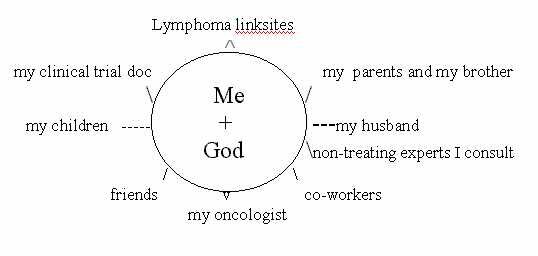
Teamwork
How do we handle the doctor who is not a ‘team’ player?
From Daisy:
I am reminded of an experience I had with an oncologist. This was not for NHL but for another cancer…I was with a dear family member and it was a very difficult visit for us both. I had researched the cancer…had a list of questions and felt worried about the harsh reality we needed to confront - but at least I felt prepared. After I asked a number of questions, this oncologist, a very, very highly respected man in his field, looked at me with controlled anger and annoyance and said: “ You read too much ... stop it.” I was devastated.
I personally had the experience of seeing the head of the lymphoma department at Memorial Sloan Kettering in NY. He phoned my oncologist after my visit and told him I talked too much – asked too many questions. He insisted that my oncologist convince me to have CHOP.
From Buddha:
In the beginner’s mind there are many possibilities, in the expert’s mind there are few.
The world is in a transition period. The Internet has opened up a world that didn’t exist for cancer patients a decade ago. We are better educated. Doctors must re-adjust their thinking. Old habits die hard for some.
From Myrna:
I sit here sometimes and read posts from people who are sick and people who are caregivers, and I truly wonder where our heads are. Are we crazy? Don’t we realize that we are truly a tremendous power, with much ability to change things?
I volunteered to HIV groups and I was in awe to see their attitude toward abuse from any quarter. Quite simply, it was ZERO TOLERANCE. I have friends with HIV and have gone with them to their doctors. They believe in themselves, believe in their power, and would never let any doctor, or anyone belittle them or their illness. I have never seen such compassion given by docs to their patients.
Moral: We have all had – or will have – such experiences. We must remember that we
do have choices. Consider your child doing poorly in school because of numerous conflicts with his teacher…wouldn’t you, the parent, strive to make changes for
your child so that he/she can have a positive school experience? Our oncologists need to be an integral part of our team – not an antagonist. If need be, choose another oncologist.
One can have a good relationship with the oncologist and still have exhausting issues to address; the answer: Communication, Compromise:
Problem: We’ve all had that long wait – hours in the waiting room. My husband accompanies me to every office visit, treatment , etc. and he is a very busy man. For that matter, my time is incredibly precious to me. So, when I sat in the waiting room with so many other patients, and most were there to see my oncologist – I waited 20 minutes and then got up and left. Solution: When my oncologist phoned me later – he and I developed a plan that has worked for us for years. He has two office sites, one a busy cancer center with lots of treatments taking place and the other a slower paced setting. I now only see him at the latter site. And I make any appointments for first thing in the morning. If he’s late due to an emergency or being held up at the hospital, at least I won’t be the victim of that later and later time as the day wears on. Communication is key.
Problem: You’ve had your visit with your oncologist but have to wait in a waiting room for lab work to be analyzed. Solution: Consider having it drawn a day or two earlier so that the results are ready to review with your oncologist at the time of your visit.
Problem: You’ve been called back to the examining room and you can hear the doctor down the hall with another patient. Time ticks away. Solution: This is when you should have your book or magazine with you.
***I’m an old ‘home-care’ nurse and saw no reason why I couldn’t have my treatment done at home. My oncologist disagreed vehemently. We had many harsh conversations about it. In the end, I had the treatments done in the hospital. But he made sure I had a private room and it was done on a weekend so my husband could be with me.
Moral: Compromise.
Important tips:
1. Always have someone accompany you to MD visits or treatments. Or take a tape recorder. Fear and anxiety prevent us from always hearing and understanding everything told to us.
2. Visit your oncologist with a list of questions or comments – written. Again, stress can affect your memory.
3. When initially diagnosed, or when it’s time for additional treatment, it is highly advisable to seek a ‘second opinion.’ Good physicians expect this and support it. If yours doesn’t, get a new oncologist. When searching for a second opinion, go outside of your oncologists’ practice. Doctors working together tend to receive the same information and tend to think along the same lines. Also, seek a ‘lymphoma specialist’ if at all possible. Let the experts you consult know you are not seeking treatment from them; and that you want to review all your treatment options, including clinical trials.
In Summary:
Be active – or proactive - in your own health care. If you don’t feel well enough to take on this task ,or you are too busy with some other facet of your life – assign the task to someone else on your team. Think carefully about any treatment decision made. Utilize all resources in making that decision.
Knowledge is power, fear is of the unknown.
From Buddha:
Do not blindly believe what others say, even the Buddha. See for yourself what brings contentment, clarity, and peace. That is the path for you to follow.
|


.gif)