|
Guidelines at Diagnosis | About Clinical Trials |
|
|
evidence-based support and information |
|
|
|
|
|
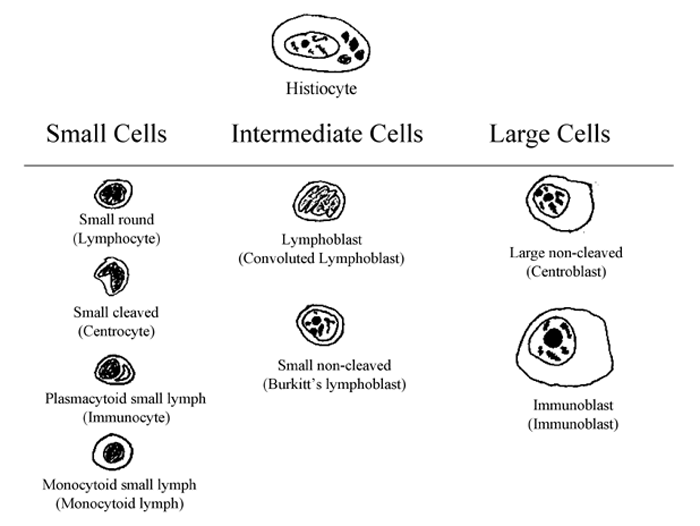
Follicular NHL grading: About mixed large and small cell:
Grade 3 confusion:"The WHO classification system recommends separating FL (follicular lymphoma) into three different grades according to the number of centroblasts per high-power field (hpf):
"Also, it is recommended that in addition to a grade the biopsy be scored for the amount of diffuse component present. The clinical importance of grade and diffuseness are unclear and generate much debate." ~ Halaas, et. al. (ASH 2003 - abstract) The study suggests that most cases (roughly 85%) previously classified as Follicular Large Cell Lymphoma would currently be classified as Follicular Grade 3a but that many of the cases currently classified as Follicular Grade 3 would not have been classified as Follicular Large Cell in the old system. Related articles
|
||||||||||||||||||||||||||||||||||||||||||||||||
.gif) |
A significant diffuse component predicts for inferior survival in grade 3 follicular lymphoma, but cytologic subtypes do not predict survival. Blood. 2003 Mar 15;101(6):2363-7. Epub 2002 Nov 07. PMID: 12424193
|
|
Grade 3 and anthracycline-containing treatments [such as CHOP]
|
|
Grade 3 follicular Lymphoma resource page PAL |
Lay comment: As tumor classification systems evolve, research using older systems may show different results than newer classification systems. As insights into genetic and molecular aspects of tumors are discovered it is hoped that treatment strategies better tailored to an individual's tumor will be identified. Such research is facilitated by participation in research trials.
Differentiation refers to the maturation level of the cells in question, which often defines how fast they are likely to grow.
Think of a fetus as lacking differentiation - organs not fully developed or fully functioning -- but rapidly growing to become so. A fully differentiated (mature) adult does not grow nearly as fast.
Cells that are well differentiated closely resemble mature cells and therefore tend to divide and grow more slowly. Therefore malignant cells that are well differentiated, like their normal counterparts, will tend to grow slowly.
Cells that are poorly differentiated are less mature, more likely to grow fast, and also generally more susceptible to chemotherapy.
The reason we have so many kinds of lymphomas is that immune cells have many stages of maturation ... or differentiation.
When cancer occurs it locks the cell and all it's descendants into the stage (and behavior of the stage) the stage at which they became cancerous. So in general: well-differentiated = lower grade; poorly differentiated = higher grade.
Also see Fine-Needle Aspiration in Non-Hodgkin Lymphoma: Evaluation of Cell Size by Cytomorphology and Flow Cytometry Medscape (free login req.)
|
Comprehensive review of Cancernetwork
|
|
Aggressive NHL: Oncology Board Review Manual yr 2000 PDF |
|
Overview Aggressive Non-Hodgkin's Lymphomas Lymphoma InfoNet |
|
Treatment of Intermediate-and High-Grade Non-Hodgkin's Lymphoma ACS |
Follicular, predominantly small cleaved. Most common non-Hodgkin's lymphomas, accounting for 30% of all NHLs and for 60% to 70% of low-grade tumors.
Follicular, mixed small cleaved and large cell lymphomas. Account for 20% to 30% of low-grade tumors.
Small lymphocytic, diffuse. Form well-differentiated tumors; often wide spread when diagnosed.
Diffuse, large cell lymphomas. Account for 85% of intermediate-grade lymphomas. Second most common NHL in U.S. Further categorized into other types, including immunoblastic lymphomas.
Follicular, predominantly large cell.
Diffuse, small cleaved cell.
Diffuse mixed, small cleaved and large cell.
Diffuse, small noncleaved cell (DSNC)
Large cell, immunoblastic
Small non-cleaved cell (Burkitt's or Burkitt-like)
Lymphoblastic
Lymphoplasmacytoid lymphoma (categorized typically as low-grade)
Mantle cell lymphoma (categorized as intermediate grade, although cell histology itself is low-grade)
Mucosa-associated lymphoid tissue lymphomas (MALT) and monocytoid B-cell lymphoma (low-grade lymphomas typically involving tissue in gastrointestinal tract, thyroid, breast, and skin).
Splenic marginal zone lymphoma (typically low-grade)
Anaplastic large-cell lymphomas (typically intermediate)