|
TOPICS
Background Articles | Ground rules for Debates | Recognizing Misinformation |
Non-partisan data | Expert Perspectives NEJM | Costs Topics
Affordable Care Act Resources
for Patients
|
* Healthcare.gov: The ACA insurance exchange
* NPR: Understanding the ACA Marketplaces | * Q&A
|
Perspective: Treatments for disease have potential benefits, but also side effects - including financial toxicities. Unless we're willing to let nature take its course, we can't choose to live without medical care. Medical policy is complex and virtually any policy decision will involve tradeoffs.
As we breath medicines and medical devices are being invented, increasing our choices, but also driving higher the cost of medicine overall, which is reflected in insurance premiums. We (society) are in effect victims of our own success: the wealth of the average person cannot keep pace with medical innovations - each of which we expect to have access to when the need arises.
It seems evident that to reduce the cost of medical care (to make the system sustainable) that some special interest groups (doctors, drug companies, etc.) will have to make less money. How else? Each policy remedy will be considered a challenge to a different stakeholder - who are generally well organized and can effectively lobby Congress to oppose it.
NEJM: The $640 Billion Question — Why Does Cost-Effective Care Diffuse So Slowly?
Who to blame? Health care costs (and insurance premiums) are mainly driven by the expense of drugs, medical devices, tests, and fees for services. For new drugs on patent, there no limit the cost of the drug, and no competition to limit what is charged. Get rid of patent protection, however, and you will lose incentives to innovate, the basis for progress against diseases that afflict us.
The insurance policy we purchase determines what's covered by the provider, and how much is the patient's responsibility. ACA (the Affordable Care Act) sets minimum standards to protect patients from trash health insurance policies that lead to bankruptcy in the past. The insurance policy regulations can do little to reign in the primary drivers of rising health care costs.
PubMed - Medical Bankruptcy in the United States, 2007: Results of a National Study
"62.1% of all bankruptcies in 2007 were medical; ... Most medical debtors were well educated, owned homes, and had middle-class occupations. Three quarters had health insurance. "
Insurance premium are also influenced by how many people are paying into the system - not taking a free ride and relying on the ER when they get sick - a cost that is shifted to insured Americans.
NEJM, 2010, Buying Health Care, the Individual Mandate, and the
Constitution: http://bit.ly/9FElMG
the uninsured consume more than $50 billion in uncompensated care, the costs of which are passed through health care institutions to insured Americans. Moreover, medical expenses not covered by insurance are one of the leading causes of bankruptcy in the United States ...
A functioning healthcare system is infrastructure that supports the general welfare -- akin to highways, public education, power utilities, and water systems. It enables us to live well, weather "storms," to do our best and to prosper. With access to healthcare, the independent contractor who is injured on the job can recover in order to support her family. Without this resource, the family descends into poverty when their provider is seriously hurt or gets sick.
... Further, infectious diseases will have no respect for economic boundaries - putting EVERY one at increased risk if the infection is allowed spread in those who have no access to healthcare.
There is also an economy of scale that helps to reign in prices for everyone. New drugs to better treat disease require having sufficient numbers of patients willing to enroll in the studies, and a sufficient base of people who can pay for the approved drugs and devices when the need arises - else there will be no economic incentive to innovate and develop better treatments.
Can we do better than ACA or improve it? Probably, yes. It's not easy to know how ACA compares to what would have been without it. It's easy for candidate to state what you will get rid of and repeal. It's also easy to misrepresent ACA - such as that it's "government insurance." It is not: it is government regulation of private insurance - setting standards to help to prevent medical bankruptcy, and requiring that they compete by offering apples to apples plans.
PBS.org - Health Care Systems -- The Four Basic Models
What will come next will depend on who is elected and what their plan is. As a start, ask the candidate about the over-arching goal of the policy he or she is proposing; and that they be specific about what they will change and what the tradeoffs will be. For example: Will their plan allow insurance providers to exclude or price out the sick? Will it remove standards for what is covered?
Finally the following article supports what common sense tells us: that insurance status affects survival and we therefore have an ethical obligation to create policy that helps the public to received timely access to medical care.
Disparities in survival by insurance status in patients with Hodgkin lymphoma -
Parikh - 2015 - Cancer - Wiley Online Library http://bit.ly/2k6Udsl
Karl Schwartz, patient advocate
Background articles
.gif) |
A physician's advice on health care policy proposals to candidates for 2016 http://bit.ly/1S9l27K
|
|
PubMed - Medical Bankruptcy in the United States, 2007: Results of a National Study
"62.1% of all bankruptcies in 2007 were medical; ... Most medical debtors were well educated, owned homes, and had middle-class occupations. Three quarters had health insurance. "
|
|
NEJM: Perspective
The $640 Billion Question — Why Does Cost-Effective Care Diffuse So Slowly?
by Victor R. Fuchs, Ph.D., and Arnold Milstein, M.D., M.P.H.
|
|
PBS.org - Health Care Systems --
The Four Basic Models - only 1 is government insurance. Which?
|
|
About the Affordable Care Act the Full Law by Section healthcare.gov
|
|
Insuring Your Health:
Looking At The Changes 2011 Brings http://bit.ly/ibyhZL
Michelle Andrews speaks with KFF's Jackie Judd about changes in lifetime insurance limits, keeping children insured, the new high-risk pools.
|
|
Finder - which program meets your needs? http://finder.healthcare.gov/
|
|
Economic Rationale for Reform prior to ACA:
1) Rosenbaum, J.D., and Gruber, Ph.D. write:
"… the uninsured consume more than $50 billion in uncompensated care, the costs
of which are passed through health care institutions to insured Americans.
Moreover, medical expenses not covered by insurance are one of the leading
causes of bankruptcy in the United States ...
Source: NEJM, 2010, Buying Health Care, the Individual Mandate, and the
Constitution: http://bit.ly/9FElMG
2) CBO Publications Related to Health Care Legislation, 2009-2010 http://www.cbo.gov/ftpdocs/120xx/doc12033/12-23-SelectedHealthcarePublications.pdf
CBO Estimated Budgetary Impact of the Healthcare Legislation
"CBO and JCT estimate that enacting both pieces of legislation—H.R. 3590 and the reconciliation proposal—would produce a net reduction in federal deficits of $143 billion over the 2010–2019 period as result of changes in direct spending and revenues (see Table 1). That figure comprises $124 billion in net reductions deriving from the health care and revenue provisions and $19 billion in net reductions deriving from the education provisions. Approximately $114 billion of the total reduction would be onbudget; other effects related to Social Security revenues and spending as well as spending by the U.S. Postal Service are classified as off-budget. CBO has not completed an estimate of the potential impact of the legislation on discretionary spending, which would be subject to future appropriation action."
http://www.cbo.gov/ftpdocs/120xx/doc12033/12-23-SelectedHealthcarePublications.pdf
About CBO: http://www.cbo.gov/aboutcbo/factsheet.cfm
|
The Politics of Medicare and Drug-Price Negotiation (Updated) http://bit.ly/2s1X7ox
|
|
Health Insurers Break Profit Records
as 2.7 Million Americans Lose Coverage http://bit.ly/92JBoC
|
|
NEJM: Buying Health Care, the Individual Mandate, and the Constitution http://bit.ly/9FElMG
|
|
NAIC: Why does the law require me to purchase health insurance coverage?
"The key goal of the health care reform law is to ensure that nobody can be denied coverage or be priced out of coverage due to a health problem.
If you allow people to wait until they have a health problem to purchase insurance, the health insurance market simply will not work. There would be a small number of very expensive choices for everyone.
So, the law requires that everyone have minimum coverage, creating a larger pool of both sick and healthy individuals." (NAIC: National Association of Insurance Commissioners)
|
|
More Q&A: http://bit.ly/9E5RKJ
|
|
About the NAIC (National Association of Insurance Commissioners) naic.org
|
|
Be Not Afraid, NEJM - Len M. Nichols, Ph.D. http://bit.ly/aamAPV
"The objective truth is that we cannot begin to get our fiscal house in order until we control the growth of costs in Medicare, Medicaid, and the entire health care system. We cannot achieve this without government action. Not a government takeover, but government action. Only government can rewrite the rules of private insurance markets so that insurers thrive by helping enrollees find high-value care, not by excluding the sick."
|
|
Kaiser Family Foundation:
Implementation Timeline http://bit.ly/bZlsbh | Summary http://bit.ly/aDHmgC
|
|
What does the health-care law mean to me? http://bit.ly/d9XF4n
"This tool estimates what it could mean for your health coverage and taxes based on your income, family size and current insurance status."
|
|
ASCO on Patient Protection and Affordable Health Care Act http://bit.ly/94zNrl
|
|
CBS: A Look At What's in the Health Care Bill http://bit.ly/aAtl5f |
Text of Bill (Read it, before you critique it!)
|
| |
|
“Will Employers Drop Health Insurance Coverage because of the Affordable Care Act?”
Health Affairs 32(9): 1522–1530 http://1.usa.gov/1LCOMah
|
|
ahip.org, April 25, 2013:
Comprehensive Assessment of ACA Factors That Will Affect Individual Market Premiums in 2014 http://bit.ly/1md7vB8
|
|
|
Government Reports and Updates on Health Care Bill
 |
Insurance approval rates for clinical trial participation rose under Affordable Care Act | Science News http://bit.ly/2gNJdBS
|
|
Kaiser Family Foundation: Implementation Timeline http://bit.ly/bZlsbh
Summary http://bit.ly/aDHmgC
|
|
What does the health-care law mean to me? http://bit.ly/d9XF4n
"This tool estimates what it could mean for your health coverage and taxes based on your income, family size and current insurance status."
|
|
ASCO on Patient Protection and Affordable Health Care Act http://bit.ly/94zNrl
|
|
CBS: A Look At What's in the Health Care Bill http://bit.ly/aAtl5f | Text of Bill
|
|
Congressional Budget Office (CBO) projects Savings
statement of cost of current Health Care Bill, March 2010:
"CBO and JCT now estimate that, on balance, the direct spending and revenue effects of enacting H.R. 3590 as passed by the Senate would yield a net reduction in federal deficits of $118 billion over the 2010–2019 period.
Source: http://www.cbo.gov/ftpdocs/113xx/doc11307/Reid_Letter_HR3590.pdf
|
|
Health Care Costs and Trends of Journal- Health Affairs:
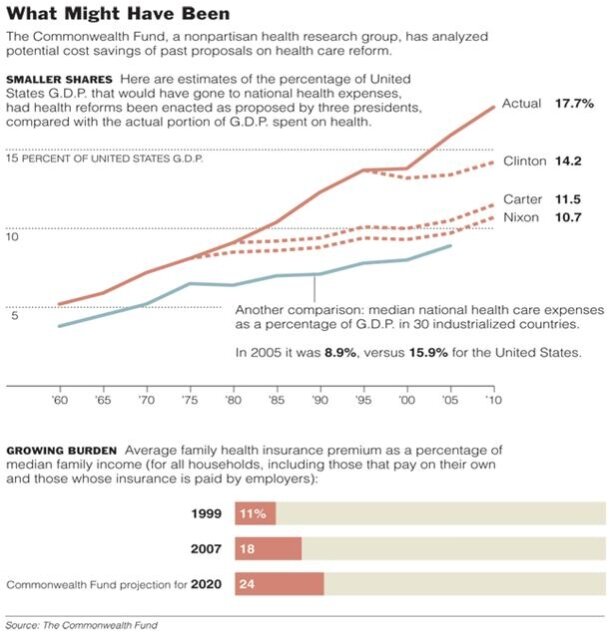
Increased health spending and decreased GDP combined to increase health care's share of the economy by 1.1 percent – the biggest one-year jump since the government began tracking the numbers in 1960. According to CMS economists writing in the journal, Health Affairs. Health expenditures are estimated to have consumed 17.3 percent of GDP last year.
Source: http://www.politico.com/static/PPM136_100203_health_projections.html
|
|
H. R. 3200 ‘‘America’s Affordable Health Choices Act of 2009’’ http://energycommerce.house.gov/Press_111/20090714/aahca.pdf
Related documents
|
|
THE BROOKINGS INSTITUTION
IMPLEMENTING COMPARATIVE EFFECTIVENESS RESEARCH:
PRIORITIES, METHODS, AND IMPACT
Another important conversation among experts … that won’t be read by the American public http://bit.ly/agMklW
|
|
President Obama's statement and goals: whitehouse.gov
|
Ground rules for constructive debate
We ask that our representatives work in a cooperative manner so that cancer patients, and individuals facing other serious medical conditions, can receive high-quality care they urgently need in a timely manner ... today and in future.
There's an urgent need to establish facts about the healthcare system and shared objectives, and to condemn the strategic dissemination of misinformation.
Yes
|
Avoid
|
|
Define terms
|
Slogans
|
|
Cite references to study data
|
Forming opinion based on opinion of others
|
|
Write letters, raise hand
|
Shout down speakers
|
|
Respect and address opposing opinion
|
Demonize opposing persons and opinions
|
|
Read source documents: Verify facts from independent sources - non-partisan, expert, non-profit ...
|
Relying on interpretations of others without verifying facts
|
|
Risk/benefit analysis (trade offs)
|
Focus exclusive to risks or exclusive to benefits (black and white)
Scare-tactics
|
|
Non-expert: focus on questions
|
Non-expert: focus on judgment
|
|
|
Recognizing Bias and Misinformation
|
Arthur Caplan, Ph.D http://www.msnbc.msn.com/id/32372258/ns/health-health_care/
|
|
Video: Fox News Kondracke blames Rush Limbaugh for inciting town hall disruptions examiner.com
|
|
Health Care 2009: "American Values" — A Smoke Screen in the Debate on Health Care Reform
New England Journal of Medicine, A. S. Brett Extract | FREE Full Text | PDF
|
|
Kill Grandma? Debunking A Health Bill Scare Tactic,
by Julie Rovner NPR.org | PAL Blog
|
Non-partisan Data / Background on US Health Care:
Based on published studies and expert testimony
-
National Coalition on Health Care http://nchc.org/facts-resources
Founded in 1990, non-profit and rigorously non-partisan
-
Impacts of Health Care Reform:
PROJECTIONS OF COSTS AND SAVINGS http://bit.ly/cUw7TW
KENNETH E.THORPE ,Ph.D . Robert W. Woodruff Professor and Chair
Department of Health Policy and Management Rollins School of Public Health
Emory University
-
The Henry J. Kaiser Family Foundation.
The Uninsured: A Primer, Key Facts About Americans without Health Insurance. October 2006. www.kff.org/uninsured/
-
Health Care Reform: Cost of Failure http://bit.ly/93t0oi
Robert Wood Johnson Foundation
Number of Uninsured Americans Could Reach 65.7 Million Within 10 Years
"In the worst case scenario, the number of uninsured Americans would increase to 57.7 million in 2014 and to 65.7 million in 2019. In the best case, the number grows to 53.1 million in 2014 and 57 million in 2019. All of these estimates assume that states would continue to maintain current eligibility levels for public coverage. Without this, the number of uninsured would be even higher."
-
EXECUTIVE OFFICE OF THE PRESIDENT COUNCIL OF ECONOMIC ADVISERS
THE ECONOMIC CASE FOR HEALTH CARE REFORM EXECUTIVE SUMMARY, June 2009 www.whitehouse.gov/administration/eop/cea/TheEconomicCaseforHealthCareReform/
-
-
Center on Budget and Policy Priorities.
The Number of Uninsured Americans is at an All-Time High. 29 August 2006 www.cbpp.org/8-29-06health.pdf
-
The Henry J. Kaiser Family Foundation.
Employee Health Benefits: 2008 Annual Survey. September 2008. www.kff.org/insurance/7672/index.cfm
-
Institute of Medicine
Hidden Costs, Values Lost: Uninsurance in America. The National Academies Press. 17 June 2003 http://www.iom.edu/Report.asp?id=12313
-
National Committee for Quality Assurance. The State of Health Care Quality, 2008, Industry Trends and Analysis. Washington, DC, 2007. The State of Health Care Quality 2008 is available to the public on NCQA’s Web site, www.ncqa.org/sohc
-
Health Plan Report Card, log on to http://reportcard.ncqa.org
-
WHO ranking of Health Care Systems, 2000 http://www.who.int/whr/2000/en/whr00_en.pdf
See table, on page 152: Annex Table 1 Health system attainment and performance in all Member States, ranked by eight measures, estimates for 1997
-
Testimony of Wendell Potter, former Insurance Executive, Before the U.S. Senate Committee on Commerce, Science and Transportation pbs.org
"As you hold hearings and discuss legislative proposals over the coming weeks, I encourage you to look very closely at the role for-profit insurance companies play in making our health care system both the most expensive and one of the most dysfunctional in the world. I hope you get a real sense of what life would be like for most of us if the kind of so-called reform the insurers are lobbying for is enacted."
Expert Perspectives: NEJM articles - links to free full text.
-
NEW Experts on Health Care Reform 2009 at http://healthcarereform.nejm.org/ Gregory D. Curfman, M.D., Stephen Morrissey, Ph.D., Debra Malina, Ph.D., and Jeffrey M. Drazen, M.D.
"A growing series that currently includes almost 100 Journal articles and online features, a diverse group of authors representing all parts of the health care system and all points of view have wrestled with the issues the country faces. The articles provide thoughtful commentary on universal coverage, comparative-effectiveness research, outcomes research, health information technology, economic challenges and cost containment, and new delivery systems." nejm.org
-
Health Care Reform — Toward More Freedom, and Responsibility, for Physicians Harold S. Luft, Ph.D. http://content.nejm.org/cgi/content/full/361/6/623
-
A Bumpy Road for Reform
J. K. Iglehart Extract | FREE Full Text | PDF
-
A Time for Revolutions — The Role of Clinicians in Health Care Reform
A. Darzi Extract | FREE Full Text | PDF
-
Achieving Health Care Reform — How Physicians Can Help
E. S. Fisher, D. M. Berwick, and K. Davis Extract | FREE Full Text | PDF
-
Health Care 2009: Congressional Action on Health Care Reform — An Update
J. K. Iglehart Extract | FREE Full Text | PDF
-
Health Care 2009: A Lifeline for Primary Care
T. Bodenheimer, K. Grumbach, and R. A. Berenson Extract | FREE Full Text | PDF
-
Health Care 2009: Easing the Shortage in Adult Primary Care — Is It All about Money?
R. Steinbrook Extract | FREE Full Text | PDF
-
Health Care 2009: The Role of Medical Liability Reform in Federal Health Care Reform
M. M. Mello and T. A. Brennan Extract | FREE Full Text | PDF
-
Health Care 2009: A Win–Win Approach to Financing Health Care Reform
J. Gruber Extract | FREE Full Text | PDF
-
Health Care 2009: The Individual Mandate — An Affordable and Fair Approach to Achieving Universal Coverage
L. J. Blumberg and J. Holahan Extract | FREE Full Text | PDF
-
Health Care 2009: A Strategy for Health Care Reform — Toward a Value-Based System
M. E. Porter Extract | FREE Full Text | PDF
-
Finding Money for Health Care Reform — Rooting Out Waste, Fraud, and Abuse
J. K. Iglehart Extract | FREE Full Text | PDF
-
Prioritizing Comparative-Effectiveness Research — IOM Recommendations
J. K. Iglehart Extract | FREE Full Text | PDF
-
Comparative-Effectiveness Research — Implications of the Federal Coordinating Council's Report
P. H. Conway and C. Clancy Extract | FREE Full Text | PDF
-
Comparative Effectiveness — Thinking beyond Medication A versus Medication B
K. G. Volpp and A. Das Extract | FREE Full Text | PDF
-
Health Care 2009: The Burden of Health Care Costs for Working Families — Implications for Reform
D. Polsky and D. Grande Extract | FREE Full Text | PDF
-
Health Care 2009: "American Values" — A Smoke Screen in the Debate on Health Care Reform
A. S. Brett Extract | FREE Full Text | PDF
-
The Next Wave of Corporate Medicine — How We All Might Benefit
D. M. Cutler Extract | FREE Full Text | PDF
-
The Shifting Mission of Health Care Delivery Organizations
R. M.J. Bohmer and T. H. Lee
Extract | FREE Full Text | PDF
-
Keeping the Patient in the Equation — Humanism and Health Care Reform
P. Hartzband and J. Groopman Extract | FREE Full Text | PDF
Financial Reports
|

