Further Reading
GLOSSARY
Amino acids: peptide building blocks of proteins.
Bases: a building block of DNA and RNA. There are five different bases or nucl: Adenine, Thymine, Guanine, Cytosine (ATGC).
DNA stands for Deoxyribonucleic acid. It's a double-stranded chemical instruction manual for cell structure and everything a cell does: grow, divide, even when and how to die.
RNA stands for Ribonucleic acid. RNA are single- stranded chemical instructions double-stranded, messenger RNA (mRNA) carries single pages of instructions out of the nucleus to places they're needed throughout the cell.
RNAi stands for RNA interference
 TOPIC SEARCH TOPIC SEARCH
Google Scholar
Polypeptides: chains of amino acids. Proteins are made up of several or many polypeptides.
Proteins: Molecules that make up the unique cell structure (skin, heart, long, immune cell) and carry out activities throughout the body, such as pumping blood (heart cells), to migration (immune cells).
encoded protein: the recipe for protein as contained in messenger RNA (mRNA).
Ribosomes are message centers throughout the cell where the information from DNA arrives in the form of messenger RNA. Here the RNA message gets translated into a form the ribosome can understand and tells it which protein building blocks it needs and in what order to assemble them.
SNPs (polymorphisms) (markers of biologic diversity)
... "the DNA sequences of two unrelated humans vary at millions of bases. ... we are each thus heterozygous at about 3 million bases. Many efforts are currently under way, ... to catalogue these variants, commonly referred to as "single-nucleotide polymorphisms" (SNPs), and to correlate these specific genotypic variations with specific phenotypic variations relevant to health.
Some SNP–phenotype correlations occur as a direct result of the influence of the SNP on health. More commonly, however, the SNP is merely a marker of biologic diversity that happens to correlate with health because of its proximity to the genetic factor that is actually the cause." NEJM
Transcription is the process where messenger RNA information is obtained from DNA information.
Translation is the process where messenger RNA information is interpreted in the Ribosome and used to assemble the end product - the unique proteins that determine cellular activity.
Resources: postmodern.com
Methylation can cause the over- or under- expression of genes
DNA methylation - is a hallmark of cancer. Specifically, it is the addition of a methyl group to specific cytosines (the components of DNA) that regulates gene activity.
Tumor suppressor gene methylation in follicular lymphoma: a comprehensive review http://bit.ly/4Eih9o
One analogy for methylation is that of a car with an ignition that is filled with a glue (methyl). The ignition (the gene) cannot be turned off so the car runs continuously.
Scientists are looking for agents that can turn off or inhibit the undesirable methylation (remove the glue that is specific to the tumor promoting, or tumor silencing, genes).
In summary, malignant behavior (loss of growth control or inability to die) can be caused by damaged genes (i.e., translocations) and also by methylation which alters which genes are turned on or off.
Hypermethylation can cause oncogenes to produce proteins that cause malignant behavior.
Hypomethylation can quiet genes that normally suppress cancer (tumor suppressor genes).
In this modification, methyl (CH3) groups are added to the DNA of specific genes within the cell at specific sites. These groups sit on the DNA and block certain proteins from binding. In this way, the DNA methylation could be stopping the cell from operating normally, Teitell said.
"By silencing cellular genes, this type of modification is damaging a cell's ability to sense its environment and may be causing it to grow uncontrollably," Teitell said. unisci.com
About
ermm.cbcu.cam.ac.uk pdf
Chromatin Remodeling - Protein fibers called histones that interact with DNA. Drugs that inhibit histone deacetylases, for example, may activate tumor suppressor genes.
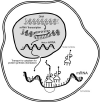
Illustration of
mRNA transcription
- Click to enlarge
|
Bad Recipe
There appears to be three reasons driving the bad behavior of malignant cells, which may be targeted by therapy:
.gif) |
Genomic - mutations in DNA, which provides the recipe for proteins that determine cell behavior.
|
|
Transcription - "The instructions stored within DNA are read and processed by a cell in two steps: transcription and translation." -- pathways, which can be targeted by therapy.
|
|
Epigenetic - or the non-DNA-related drivers of malignant behavior, such as DNA methylation - which regulates which genes (tumor promoters / repressors) are turned on or off.
We might assume that the genomic event (DNA mutation) happens first , but the downstream activities (transcriptional and epigenetic) are required to carry out the bad recipe ... furthering the abnormal growth and persistance of the lymphoma cells.
|
For a cancer to develop, internal and external defenses against cancer are suppressed. Tumor suppressor genes are inactivated or mutated (internal defense). Genes that suppress cancer (repair, induce cell death when damage is detected) are silenced. Reactivating these genes is a promising approach to treating cancer. (epigenetic agents that reactivate silenced genes)
Tumors turn on factors that suppress or evade the immune system (external defenses). Targeting these factors can reactivate the immune system to fight the cancer (antibodies that target immune checkpoint blockade)
See also Epigenetics - and diet below
About Genes and DNA
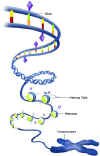 Here we provide basic terms to help you to understand how genes and gene expression contributes to cancer, and how recent insights may lead to new drugs that target the underlying causes of malignancy. Here we provide basic terms to help you to understand how genes and gene expression contributes to cancer, and how recent insights may lead to new drugs that target the underlying causes of malignancy.
DNA stands for Deoxyribonucleic acid. It is the "instruction manual" for the manufacture of cell proteins that determine cell structure and activity, including growth and survival.
DNA exists in all cells except mature erythrocytes.
The DNA "manual" contains thousands of pages called genes.
DNA is made up of bases (nucleotides) that are arranged in a specific sequence. The specificity of the sequence accounts for the production of a specific protein.
Gene function, which determines how cells grow and survive, may be altered by either a change (a mutation) in the sequence of the DNA or a change in epigenetic programming of a gene -- like the "chapters of the book" that are read (excessively) or not read.
Genes contain the instructions or recipes for the assembly of unique proteins. Some of these proteins are related to cell growth and survival.
RNA: In order for DNA to produce a protein, an intermediate step is required.
... In this step, DNA is transcribed into RNA. The sequence of mRNA that encodes a protein is oriented in only one direction, which is known as the "sense" orientation.
Oncogenes are mutated and/or over-expressed versions of normal genes that can cause a cell to lose growth restraints, fail to differentiate (mature to a next stage), or prevent the cell from initiating the programmed cell death process called apoptosis. Some oncogenes turn on other genes that can promote malignant behavior.
Tumor suppressor genes are genes that protect cells from becoming a cancer. They may put the brakes on accelerated growth, or initiate cell death when DNA damage is detected. Therefore, the low expression of tumor suppression genes can lead to cancer.
Epigenetic refers to the regulation of gene expression - how, when, where, how much, that is not due to DNA mutations.
Two key areas of epigenetic control are
Chromatin Remodeling and
DNA Methylation (see Sidebar for details)
It is possible to reverse aberrant gene expression (such as genes that drive proliferation (oncogenes) or genes that fail to detect and stop malignancy (tumor suppressor genes).
Several epigenetic drugs targeting the DNA methylation and histone deacetylation enzymes have been tested in clinical trials; some have recently been approved.
Targeted therapeutics may be designed to offset the over-expression of oncogenes, or the silencing of tumor suppressor genes ... that is, treatments can influence epigenetic regulation of cells.
* "Over expression of some genes may be responsible for some forms of cancer; gene silencing and inactivation techniques could be a cure for these diseases." bama.ua.edu pdf
|
Antisense RNA experiments lead to the discovery of RNAi.
|
|
RNA Interference [RNAi] - post-transcriptional gene silencing.
"The antisense approach to gene silencing involves injecting an organism with RNA sequence complementary to mRNA transcribed from a target gene. The antisense RNA and sense mRNA hybridize and block translation and the production of an encoded protein. The presence of dsRNA duplex led to what we now recognize as an RNA interference effect."
Source miami.edu
Details on RNAi macalester.edu
|
|
Gene silencing is any method of interfering with transcription or translation of a gene and the protein it produces.*
|
|
Gene inactivation is any method that modifies the DNA or proteins around the DNA that prevents transcription * of DNA into RNA and thus the encoded protein.
|
Molecular Biology is the path from DNA (recipe) to proteins that carry out activity
| DNA > |
RNA > |
> Protein |
| Original instruction manual |
Transcribed page of the manual |
End product |
| Alphabet ( blocks) of information: |
Alphabet (blocks) of information:
|
Assembled sequence of amino acids |
| Double stranded information |
Single stranded information |
Functioning product. Information on how protein is made is not possible at this point |
| Error detection and repair |
No error protection or repair |
No error protection or repair |
| Location: within the nucleus |
Location: transcribed outside nucleus to areas of cells where it can be translated into assembly of proteins |
Location: varied cell locations |
| Cancer: a mutation in the DNA - one, or more, of the four letters of the DNA is replaced by another letter, or due to deletion or insertion of one or more letters, in one or more DNA regions |
Cancer: the transcription and translation of mutated areas of DNA |
Cancer: abnormal amounts or types of protein that causes loss of growth control or prolonged survival of the cells - malignant behavior |
about polymorphisms
Polymorphisms are normal variations in DNA sequence between individuals. There are about 60,000 polymorphisms in human genome
But why does it matter to patients?
A big reason for the variable toxicity and efficacy of drugs is that we are not the same .... on a genetic level. Our cells may produce different enzymes and amounts based on normal genetic variations (polymorphisms) ... the recipes for cellular proteins. Enzymes, for example, that degrade, or fail to degrade, a given drug can increase toxicity or limit efficacy.
Vincristine for example: The variable half life of vincristine accounts for the toxicity it can produce when the body does not degrade it fast enough.
Anyhow, it's possible to identify the polymorphisms that influence drug metabolism so that we can give the "right drug, at the right dose, to the right patients."
More on the subject: "Genetic variations in the response to drugs can cause measurable differences in clinical endpoints such as rates of cure, morbidity, side effects, and death. Data in this category demonstrate that genetic variability in the context of a drug effect significantly changes medical outcomes. These data sets are different from pharmacodynamics data sets, which may show a difference that is not sufficiently significant to alter practice or policy." pharmgkb.org
See also ncbi.nlm.nih.gov 11937185t
Related Terms
DNA methylation - is a hallmark of cancer. Specifically, it is the addition of a methyl group to specific cytosines (the components of DNA) that regulates gene activity.
Epigenetics - In biology, the term epigenetics refers to changes in phenotype (appearance) or gene expression caused by mechanisms other than changes in the underlying DNA sequence, hence the name epi- (Greek: over; above) -genetics. (Wikipedia)
Pharmacodynamics the study of the relationships between the concentration of a drug at its site(s) of action and the magnitude of the biological or physiological effect that is achieved.
Pharmacokinetics - the study of the bodily absorption, distribution, metabolism and excretion of drugs.
Drug - A chemical or biological substance used in the diagnosis,
treatment, or prevention of a disease or phenotype, or as a component of a
medication.
Molecular assay - an experiment in which the characteristics of a molecule (or ensemble of molecules) are measured.
Cellular Assay - an experiment in which the response or characteristics of a cell (or population of cells) is measured.
Genotype - is the internally coded, heritable information carried by the organism. Variation in genotype represents differences in sequence within a species, such as SNPs, the location or the number of
repeats, deletions, or critical splice sites.
Phenotype - the observable properties of an organism produced by the interaction of the genotype with the environment. For pharmacogenetics, the "environment" is often defined as exposure to a drug, although it may include other variables as well.
Transcription factors - "The normal growth, development and function of an organism requires precise and coordinated control of gene expression. A major part of this control is exerted by regulating messenger RNA (mRNA) production and involves complex interactions between an array of transcriptionally active proteins and specific regulatory DNA sequences." ncbi.nlm.nih.gov
|
Epigenetics
Epigenetic refers to the regulation of gene expression - how, when, where, how much, that is not due to DNA mutations.
Factsheet on epigenome http://www.genome.gov/27532724
snip: Each person's body contains trillions of cells, all of which have essentially the same genome. Yet some cells are optimized for use in muscles, others for bones, the brain, the stomach and the rest of your body. What makes these cells different?
The protein-coding parts of your genome, called genes, do not make proteins all of the time in all of your cells. Instead, different sets of genes are turned on or off in various kinds of cells at different points in time. Differences in the types and amounts of proteins produced determine how cells look, grow and act. The epigenome influences which genes are active - and which proteins are produced - in a particular cell.
In the News and Related Resources
|
Scientists just made the first map of the human epigenome. The Washington Post http://wapo.st/17joH2e
|
|
NIH Common Fund Epigenomics http://1.usa.gov/1Ednu9x
|
|
Factsheet on epigenome http://www.genome.gov/27532724
|
Epigenetics as basis of diet as treatment of cancer?
Although dietary photochemicals appear to play a role in cancer prevention a number of issues need to be addressed before moving forward to evidence-based guidelines - such as to identify by well-designed study which of the myriad types of foods have protective effects against the development of different kinds of cancer. Still, it makes good sense to follow mom's advice (and the surgeon general's) to eat a variety of vegetables and fruits on a regular basis!
Based on our review of publications within, there is no scientific evidence showing that the potential epigenetic effects of diet can influence the course of a preexisting lymphoma. Here we have neither mom's advice, nor the advice of the surgeon general. We have instead a layperson's conclusion that his better-than-typical (but not uncommon) outcome was due to the diet he recommends for others. (He is certain that A led to B, and that it can help others too.)
... We are genuinely happy for all good outcomes in patients. However, as always, testimonials stating that A led to B cannot account for good luck (the variable natural history of indolent lymphoma, which has significant molecular variation) and the influence of standard treatments in individual cases.
We suppose that demonstrating a proof of principle (for the diet theory) in animal models would be a first step .. to see if this approach is plausible and warrants further study. Our literature query (as of 4/2105) comes up empty for study of diet as an intervention for lymphoma - showing only prevention abstracts.
While there appears to be no risk associated with the dietary practice, the unsupported claim can be used by individuals to sell subscriptions and books; it also moves the focus of patients away from considering research options when treatment is needed ... that are more plausible -- that are already in clinical-phase testing.
Finally, people who will make such claims without medical training and without supporting evidence may also persuade patients to consider other implausible and unscientific interventions ... and to mistrust their doctor's advice.
In summary:
That diet can prevent cancer remains plausible. Epigenetics might explain the observed associations of diets with different cancers. Noting that, for lymphoma, dietary factors are weakly and inconsistently associated with the disease.
The increasing understanding of epigenetics does not support at this time any specific diet as an intervention for an existing lymphoma; or which dietary compounds (at what doses) might have positive or negative effects on the parts of cells that influence gene expression.
Perspective by Karl Schwartz
Publications on epigenetics and diet:
|
A good primer: Epigenetics Changes in Cancer Cells http://1.usa.gov/1BesVBy
Cancer is a genetic disease initiated by alterations in genes, such as oncogenes and tumor suppressors, that regulate cell proliferation, survival, and other homeostatic functions. In cancer cells, genes are either modified by mutations, which alter the function of the proteins they encode, or through epigenetics -- modifications to chromosomes that alter gene-expression patterns. This can occur through DNA methylation, and methylation, acetylation, or phosphorylation of histones and other proteins around which DNA is wound to form chromatin. Little is known about how these chemical modifications occur in the DNA of cancer cells, but they can affect the expression patterns of oncogenes or of tumor suppressor genes. For example, DNA methylation induces "epigenetic silencing" or the loss of expression of tumor suppressor genes, causing normal cells to be transformed into cancer cells
|
|
The Role of Dietary Histone Deacetylases (HDACs) Inhibitors in Health and Disease http://1.usa.gov/1vEfUgJ
|
|
Nutrition and the Epigenome http://bit.ly/1Betf2Z
|
|
Diet, epigenetic, and cancer prevention. - PubMed - NCBI http://1.usa.gov/1wv79oq
|
|
Cancer chemoprevention and nutriepigenetics: state of the art and f... - PubMed - NCBI http://1.usa.gov/1AY1Cgv
So far, data are still mainly derived from in vitro investigations, and results of animal models or human intervention studies are limited that demonstrate the functional relevance of epigenetic mechanisms for health promoting or cancer preventive efficacy of natural products.
|
|
Epigenetics: It doesn’t mean what quacks think it means « Science-Based Medicine http://bit.ly/1zMyycP
|
|
Plant Phytochemicals as Epigenetic Modulators: Role in Cancer Chemoprevention http://1.usa.gov/1wVM6k2
Future research should be directed on the translation of effect of these dietary phytochemicals to pre-clinical models of cancers and in humans. As some of the effects of these phytochemicals appear to be cell type or organ specific therefore, understanding the mechanism(s) of these differences is a key in designing a personalized regimen for cancer prevention and/or cure.
... Although dietary phytochemicals hold great promise in cancer prevention, a number of issues need to be addressed before moving forward to evidence-based clinical trials.
|
|
Dietary HDAC inhibitors: time to rethink weak ligands in cancer chemoprevention? http://1.usa.gov/1txqV8o
snip: Studies with dietary HDAC inhibitors are in their infancy, but we believe it is important not to dismiss these agents simply because they are weak ligands; their ability to modulate gene expression in subtle ways and, through a lifetime of exposure, to impact cancer chemoprevention warrants further investigation.
|
|
Intake of selected micronutrients and the risk of surgically treated BPH... - PubMed - NCBI http://1.usa.gov/1xsM2Ks
|
|


