 TOPIC SEARCH:
PubMed | Medscape | ASCO.org | Web
Photopheresis
Also known as extracorporeal photochemotherapy (ECP), is a form of apheresis therapy. It involves light-activated treatment of circulating blood cells outside the body.
"Photopheresis may act by modifying the patient's own immune response to his/her disease. On this basis, the therapy is being extended to graft vs. host disease, organ transplantations, and early scleroderma and other autoimmune diseases." roswellpark.org
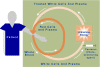
Click to enlarge image on americasblhttp://ood.org
Procedure outline
1) The patient ingests a light-activatable drug, called psoralen.
2) An IV (intravenous) line is placed in the patient, a drug called psoralen is sometimes given.
3) Blood is temporarily removed from the patients. White blood cells are separated out and then mixed outside the body with the patient's plasma, saline, heparin, and 8-methoxyposoralen. The preparation is then passed through a device where it is exposed to ultraviolet light.
4) The treated mixture and untreated blood is combined and returned to the patient. The procedure takes approximately 4 hours.
Adapted from emedicine.com
What is apheresis?
medlib.med.utah.edu
"The process of apheresis involves removal of whole blood from a patient or donor. Within an instrument that is essentially designed as a centrifuge, the components of whole blood are separated. One of the separated portions is then withdrawn and the remaining components are re-transfused into the patient or donor."
Photopheresis was first used as a treatment of cutaneous T-cell lymphoma (CTCL). It is now also administered to treat autoimmune diseases, solid organ transplant rejection, and graft-vs-host disease.

