TOPICS
Staging | Extranodal notations | Ann Arbor notations | About Stage IV | In the News
Staging defines how widespread the disease is and the locations of the disease in the body.
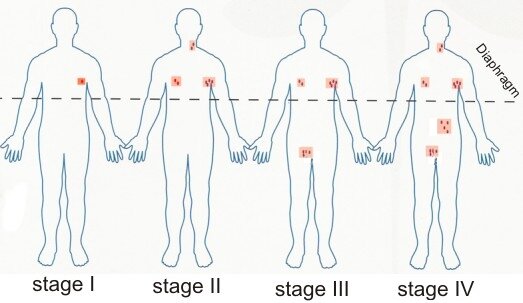
Above illustration adapted from Favrille patient education material.
Click to enlarge illustration
Ann Arbor staging for Lymphoma:
NOTE: The staging does not take into account the grade (growth rate) of the tumor tissue, or prognostic factors, such as bulky disease, LDH, age, symptomatic. See FLIPI
Bone marrow involvement and other so-called extranodal involvement is not unexpected for lymphoma can be reversed with treatment.
.gif) |
Stage I - disease in single lymph node or lymph node region.
|
|
Stage II - disease in two or more lymph node regions on same
side of diaphragm.
Note: Stage II contiguous means two or more lymph nodes in close proximity (side by side).
|
|
Stage III - disease in lymph node regions on both sides of the
diaphragm are affected.
|
|
Stage IV - disease is wide spread, including multiple involvement at
one or more extranodal (beyond the lymph node) sites, such as the
bone marrow (which is involved commonly), liver, pleura (thin lining of the lungs).
|
Also see Extranodal and Ann Arbor notations below,
which may be added to the above staging designations.
Also see
|
Prognostic Factors (FLIPI, IPI, MIPI) PAL
|
|
CLL Staging (Rai | Binet)
|
|
Staging Cancer.org
|
|
Staging Oncologychannel.com
|
|
Value of PET imaging in Follicular Lymphoma: Discussion http://www.medscape.com/viewarticle/583796_4
|
|
Recommendations for Initial Evaluation, Staging, and Response Assessment of Hodgkin and NHL The Lugano Classification http://bit.ly/1pwwzEF
|
|
Dr. Sharman's CLL & Lymphoma Blog
Follicular Lymphoma Grade and Stage http://bit.ly/17o8Kkl
|
CLL Staging (Rai | Binet)
MALT Staging and Workup - PAL
 Extranodal notations
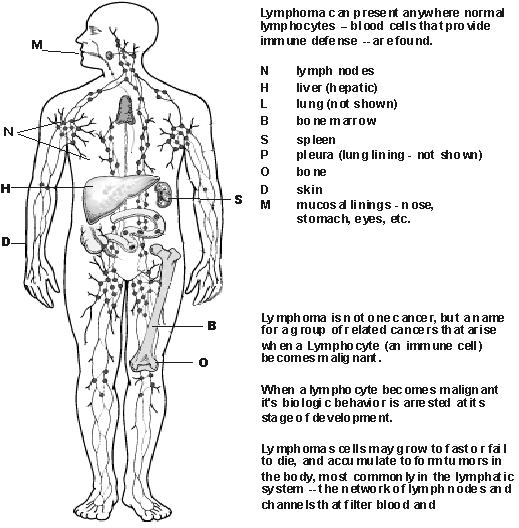
Extranodal means 'beyond nodal' - sites are identified by the following notation:
| N |
= lymph nodes |
| |
|
| E |
= extranodal |
| H |
= liver (hepatic) |
| L |
= lung |
| M |
= bone marrow |
| S |
= spleen |
| P |
= pleura (lung) |
| O |
= bone |
| D |
= skin (dermis) |
You can click the image on the right to enlarge it.
Disease Staging may also be accompanied by local involvement of an extranodal organ or site.
Example involving spleen: Stage IIIS
ANN ARBOR notations
Ann Arbor staging further classifies patients with lymphoma into A or B categories
A = without symptoms
B = with symptoms including unexplained weight loss (10% in 6 months prior to diagnosis, unexplained fever, and drenching night sweats.)
E = Extranodal means 'beyond nodal' (see above)
Disease Staging may also be accompanied by local involvement of an extranodal organ or site.
Example involving spleen and Ann Arbor notation: Stage IIIS A
About STAGE IV
It is common for b-cell lymphomas to be diagnosed at stage IV, and with bone marrow involvement. While dependant on the cell type and other factors, successful treatment is often possible for stage IV disease and bone marrow involvement is reversible!