|
Guidelines at Diagnosis | About Clinical Trials |
|
|
evidence-based support and information |
|
|
|
|
|
||||||||||||||||||||||||||||||||||||||||||||||||||||||||||||||||||||||||
.gif) |
Dr. Sharman's CLL & Lymphoma Blog:
|
|
Lymphoma in more detail |
|
Risk factors associated with developing lymphoma |
|
Lymphoma classifications |
|
Lymphoma statistics |
|
Lymphoma symptoms |
|
Lymphoma simplified:
|
|
History of Cancer Cancer.gov |
|
Cancer 101 Webcast |
|
Understanding cancer series nci.nih.gov |
______________________
Defining Cancer
In normal tissues, the rates of new cell growth and old cell death are kept in balance.
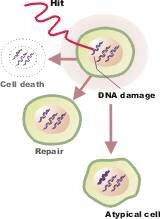
In cancer, this balance is disrupted. This disruption can result from uncontrolled cell growth or loss of a cell's ability to undergo "apoptosis."
Apoptosis, or "cell suicide," is the mechanism by which old or damaged cells normally self-destruct."
Source: http://press2.nci.nih.gov
Lymphomas are often very sensitive and responsive to different treatments.
Aggressive lymphomas are often cured, and indolent lymphomas are often managed well when treatment is indicated.
Importantly, recent advances in the understanding of lymphoma have led to effective new therapies.
Our body is made of countless cells of many types. Cells have specialized jobs and names, such as skin, nerve, heart, lung, blood, immune cells, and so on. For the human body to function normally, each organ must have a certain number of cells.
By design, the cells in most organs have a short lifespan. Therefore, to continue functioning the body needs to replace these lost cells by the process of cell division.
Cell division and cell death are controlled by genes that are located in the cell nucleus. Genes function like an instruction manual telling the cell what proteins to make. These proteins in turn control the behavior of the cell.
Some proteins direct the cell to divide; others how long it will live; and others begin cell death - a normal process by which the body rids itself of old, unneeded, or damaged cells.
Under normal conditions there is a balance in which new cells replace old, and each cell carries out tasks specific to its kind: Heart cells pump, stomach cells produce acids, immune cells recognize invaders and kill them, and so on. The balance ensures that the organs and systems function properly and serve the needs of the body.
_________________________________________________
The beginning of cancer
In any cell the genetic code can get damaged so that the instructions in the "manual" are altered in ways that produce abnormal types and amounts of proteins that can lead to abnormal behavior of the cell.
... Instead of resting, the cells may continue dividing; instead of dying the cells stay alive. Mutations may also turn off genes that can repair damaged DNA, or that can induce cell death when mutations in the cell are detected. See also tumor suppressor genes
Lymphocytes are very active cells, which undergo many normal transformations in their life cycle and many more cell divisions than most other cell types. They are designed to divide rapidly to address infections, but also to die off fast when the infection is under control.
Cell division, being a highly complex process, is prone to mistakes. Mistakes may not be "picked up" or may often be inconsequential. The defective or atypical cell will not necessarily lead to a cancer, however ... additional errors must occur. Before it becomes a cancer the parent cell divides many times, passing on the defects that have malignant potential to the children cells. Additional "hits" on the atypical cells may result from chemical exposures, viral infections, oxidation, random errors ...
For example: An atypical (slightly defective) lymphocyte may be kept active longer because of chronic stimulation by a bug or virus (chronic infection being associated with higher risk of acquiring lymphoma) - making additional random copy errors more likely to occur.
... The first cell to lose normal growth control is called the cell of origin. When the cell of origin divides, the new cells inherit the genetic defects of the parent cell. Thus, in cancer, the descendants of the cell of origin are clones of this cell.
A hallmark of cancer cells is that they have growth and survival advantages over normal cells. Their cell division is not balanced by cell death. The abnormal cells may eventually form lumps called tumors.
The word tumor simply means a mass of cells. Tumors can be either benign or malignant. Benign tumors are not a threat to life or long-term health, while malignant tumors are. The word malignant means 'showing great malevolence and being disposed to do evil.' One way that pathologists identify a tumor as being malignant is if the cells within it are clonal - all identical to the cell of origin. In contrast, benign tumors are made up of related but different cells.
The hallmarks of cancer cells include:
|
Limitless potential to divide and grow |
|
Resisting cell death (resisting apoptosis - normal programmed cell death) |
|
Evasion of detection by the immune system |
|
Inhibition of immune action (immune checkpoint blockade) |
|
Development of a sustaining blood supply (angiogenesis) |
|
Self sufficiency in growth signals |
|
Insensitive to anti-growth signals |
|
Tissue invasion and metastasis (spreading beyond the organ of origin) |
|
Reprogramming of energy metabolism |
|
Recruitment of normal cells that contribute to the acquisition of hallmark traits by creating the "tumor microenvironment."* |
|
Update: Hallmarks of cancer: the next generation. |
_________________________________________________
Lymphoma is a kind of blood cancer
Blood is a fluid made up of plasma and many types of blood cells, such as red blood cells (erythrocytes), white blood cells (leukocytes) and platelets. Blood circulates through the heart, arteries and veins. It carries "nourishment, hormones, vitamins, antibodies, heat and oxygen to the body's tissues." labtestsonline.org
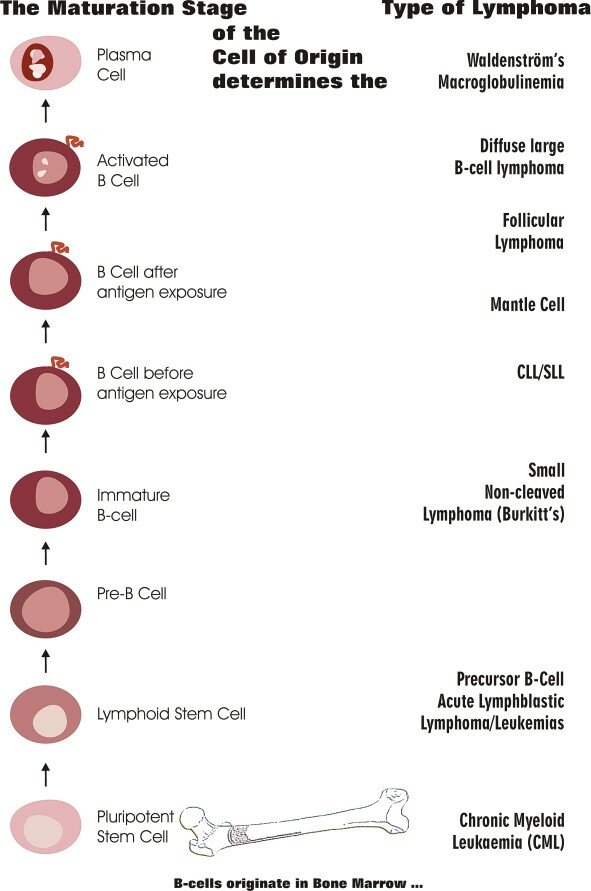
B-cell Cancers by Cell Maturation Stage - Click to enlarge
Lymphoma is a cancer that affects a type of white blood cells called lymphocytes – immune cells that normally protect you from illness. About 85% of lymphomas are of b-cell origin, and 15% of t-cell origin.
B-cells originate and mature (differentiate) in the bone marrow.
T-cells also start out in the bone marrow, but they differentiate and mature in the thymus gland.
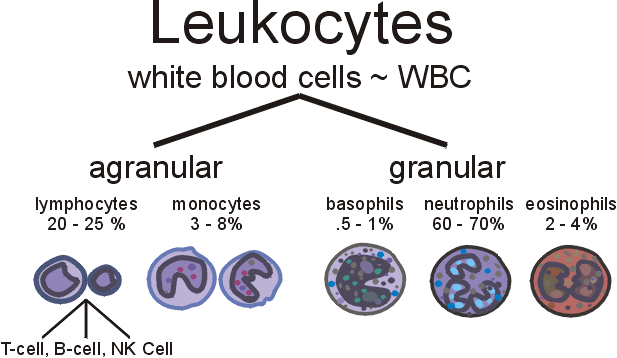
Natural Killer cells are a third kind of lymphocyte. They specialize in killing foreign cells and possibly signaling to alert other immune cells of invaders.
Leukocytes - Click to enlarge
The different types of lymphoma are determined according to what type of lymphocyte has become cancerous, and the stage of development. Click b-cell cancers by cell development to enlarge the illustration shown above.
As with other cancers, the root cause of lymphomas is damage to genes that leads to abnormal (deregulated) growth controls in the cell.
|
|
|
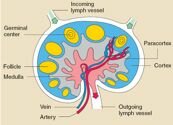
| Lymph node |
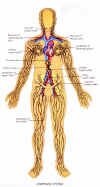
Lymphatic system |
________________________________________________
Lymphomas are a Family of Related Cancers.
The cell of origin determines the subtype of lymphoma, and influences its clinical behavior - growth rate and sensitivity to treatments.
The cell of origin, such as T-cell, B-cell, and NK cell, and the stage of maturation of that cell determines the type of lymphoma. This is often referred to as the cell type or diagnosis, such as follicular small cleaved lymphoma.
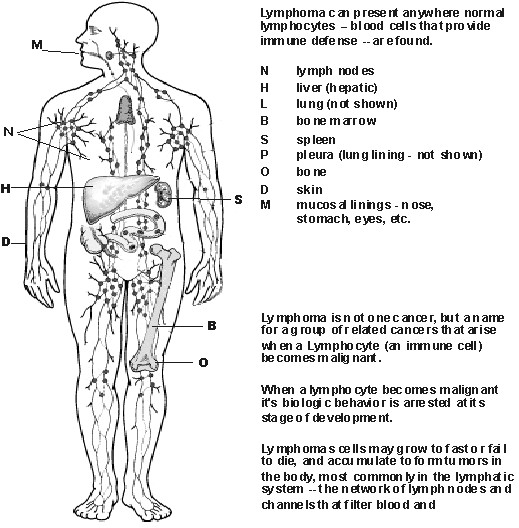
When a lymphocyte becomes malignant, its biologic behavior is arrested at that stage. This stage of development influencing its location tendencies and growth rate and other cellular behaviors.
Analogy: Consider that just as children grow faster than adults, cells at earlier stages of development tend to grow faster than they do at mature stages.
The malignant cells then may accumulate to form tumors that enlarge the lymph nodes or spread to other areas of the lymphatic system, such as the spleen or bone marrow, or outside the lymphatic system to the skin, or mucosal linings of the stomach.
How widespread the lymphoma is, is summarized by the stage. Staging is the process of determining where the lymphoma is located by imaging and other methods.
NOTE: It's common for the lymphoma to be at stage IV at diagnosis. But, advanced stage of disease does not mean the treatments will not be effective.
About growth rate. The cell of origin will also influence how fast or slow the lymphoma cells will tend to grow. The growth tendency of the lymphoma is also called the grade.
Aggressive grade lymphomas divide and grow rapidly, and therefore prompt and aggressive treatment is indicated.
Indolent grade lymphomas may not divide faster than normal lymphocytes. Here the malignant behavior can be resistance to cell death - a failure to "erase" itself after it's normal functions have been completed. This results in a slow buildup of excess cancer cells causing tumors to form, but more slowly.
________________________________________________
Mutations also influence the clinical behavior
The specific damage to DNA - and the gene expression - is likely to be variable for patients who have the same diagnosis.
These differences may explain, in part, why patients with the same diagnosis can have lymphomas that develop at different rates, and respond differently to the same treatments.
Recall that genes expression determine what proteins the cells express and this determines behavior. Response to treatment is also cell behavior. For example, cells detecting damage to DNA - induced by treatment - will initiate cell death, but only if the genes that can activate the cell-death program are functioning or activated by the treatment.
"Ultimately, it may well be that the optimal treatment will be determined by patient clinical and biological characteristics." ~ Dr. Bruce Cheson - Advances in the Treatment of Non-Hodgkin's Lymphoma - Medscape (free login)
_________________________________________________
Your Lymphoma is Unique
Factors that may account for clinical differences in lymphomas:
|
The cell type: T-cell, B-cell, NK-cell, and subtypes of each; |
|
The stage of development of the cell of origin; |
|
Slight differences in stage of development; |
|
Specific damage to the genes; |
|
Different patterns of gene expression - silent versus active genes; |
|
Differences in the health, strength and characteristics of the immune systems; |
|
Differences in the microenvironment in the tumors, which are made up of malignant and normal cells. Here the interactions among the cells in the tumor may be promoting or stabilizing; |
|
The presence or absence of antigen stimulation inside the body. An antigen is defined as a molecule that is recognized by the immune system as something that does not belong in the body. |
Notable Quote: "As we move to consider these tumors by their genetic abnormality (genotype) rather than their cellular appearance (phenotype), one converts the generalities of leukemia, lymphoma, and myeloma into hundreds of diseases with distinct genetic causes, clinical manifestations, and drug responsiveness." Source
Encouraging Developments: New technologies, particularly microarrays, can help to characterize gene expression in malignant cells, allowing scientists to see what is wrong, and compare one person's cancer to another's. For the first time in history we can begin to see what we are trying to fix at a fundamental level, and this is likely to lead to rationale selection of cancer therapies, as well as faster drug development and testing. See NBN for more details.
Additional reading
|
Understanding cancer series nci.nih.gov
|
|
|


 TOPIC SEARCH: PubMed